

Last week, I visited Refik Anadol’s DATALAND, and I must say that I really wanted to like it.
I have followed Anadol’s work for a long time, and I understand the attraction of what he is trying to create. His installations are beautiful, spectacular, accessible, and joyful. At a moment when the world feels saturated with violence, fear, exhaustion, and political despair, the desire to create wonder is not something I dismiss. Beauty matters. Joy matters. Giving people a space in which they can temporarily feel amazed may be a sincere and even necessary artistic ambition.
And still, I left DATALAND deeply disturbed.
DATALAND describes itself as the world’s first Museum of AI Arts. Its inaugural exhibition, Machine Dreams: Rainforest, unfolds across multisensory galleries filled with enormous projections, immersive sound, artificial scents, and AI-generated interpretations of the natural world.
The experience is technically impressive. The screens are huge. The colors are overwhelming. Images of plants, animals, fungi, roots, flowers, and imagined organic forms move across the walls, floors, and ceilings.
But as I walked through those rooms, I kept wondering: Who is this art for? What does it ask us to understand? What kind of relationship with AI does it teach us to accept?
Admission starts at $49 for children, with VIP tickets reaching well into three digits. DATALAND is a for-profit cultural institution located inside The Grand LA, a Frank Gehry-designed luxury development in downtown Los Angeles.
This does not automatically invalidate the art. Museums, exhibitions, performances, and technological artworks all cost money to produce. I know this intimately as an artist working with AI systems, sensors, projectors, computers, speakers, and wearable technologies.
Still, the price matters when a cultural institution presents itself as a vision of the future.
Whose future is being imagined here? Who can afford to enter it?
The first gallery contains rows of vertical screens, with a personal station for each visitor. We were asked to scan our tickets, and a mysterious box opened automatically, offering us two wearable devices. A biosensor was attached to the wrist, while another device rested around the neck and released customized scents throughout the experience.
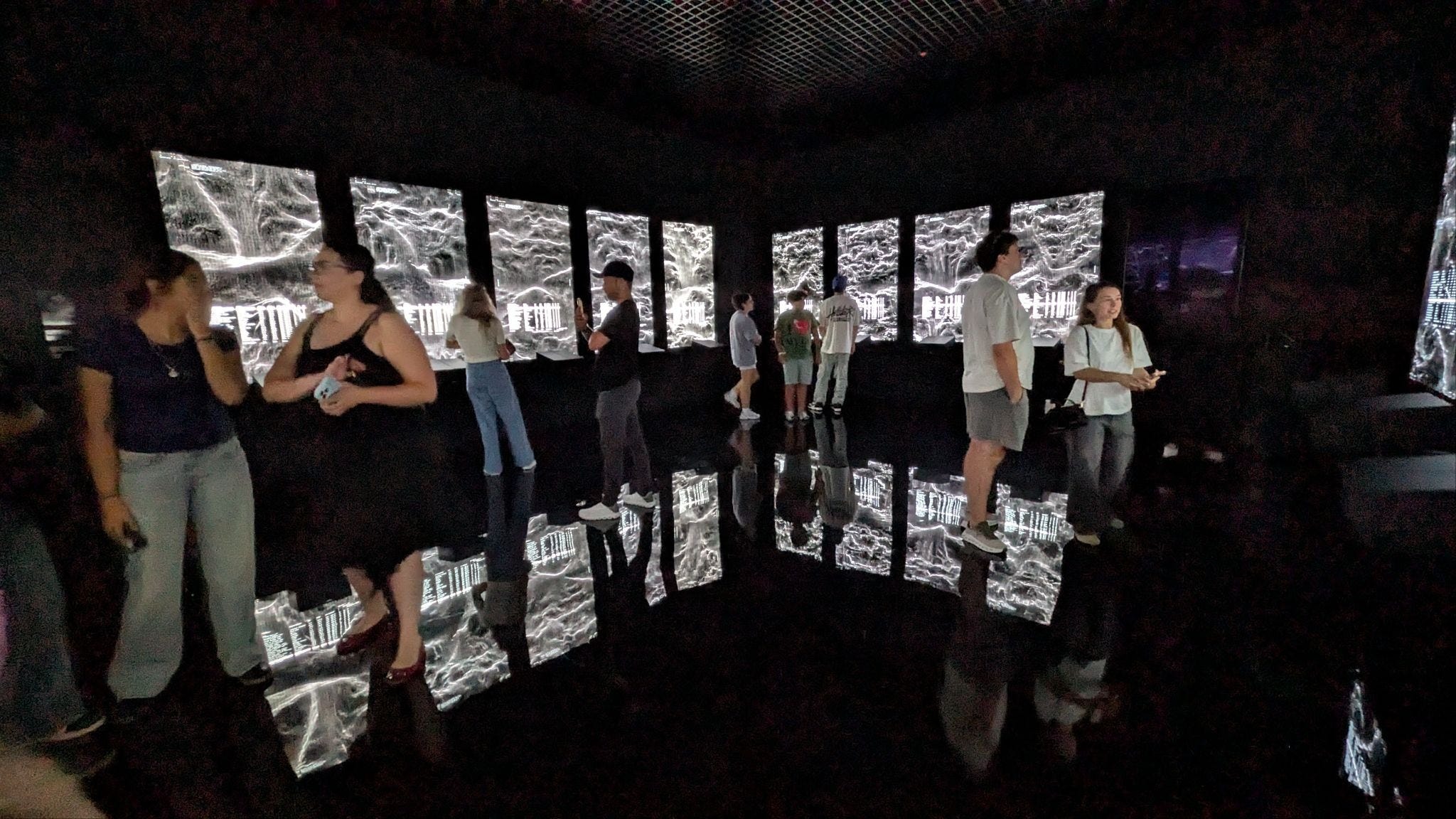
The wrist device measured physiological signals including heart rate, skin temperature, and electrodermal activity. The system also tracked movement and the amount of time visitors spent in different areas. DATALAND translated these signals into interpretations of emotional engagement, claiming that the art was responding to the audience in real time.
In other words, while you watch the art, the art watches you.
The museum’s FAQ page uses many words to explain how transparent this data collection supposedly is. The data is anonymized. Visitors can opt out. Information is not shared with third parties. Unclaimed data is deleted after thirty days.
This is all great. To be clear, I am not accusing the institution of secretly selling identifiable information or violating its stated privacy policy.
My concern is simpler and larger, and I am not the first person to point it out.
The problem is the normalization of surveillance and the lack of critical engagement with it.
Visitors sign a waiver filled with tiny words before entering. The FAQs assure us that everything is legitimate. A visitor might even be fully aware of surveillance culture. Heck, I teach a class about surveillance at UC Davis.
And still, the wearables catch you off guard.
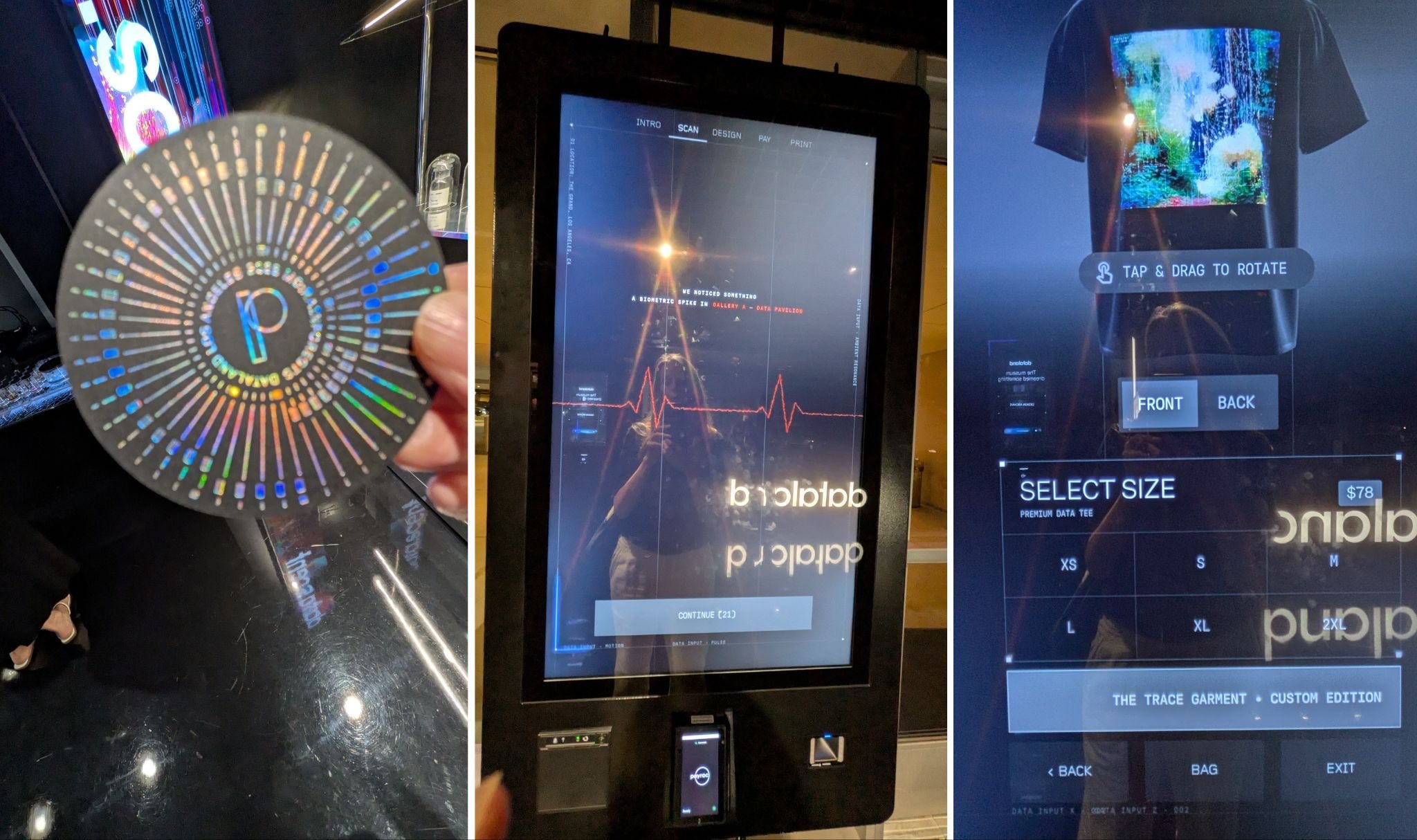
You want to participate in the experience, so you do not immediately think of the wearables as surveillance devices. They are introduced as part of the magic. Only at the end, when you receive a round cardboard token and scan it at a machine inside the gift shop, do you arrive at the aha moment: your body has been mined for data.
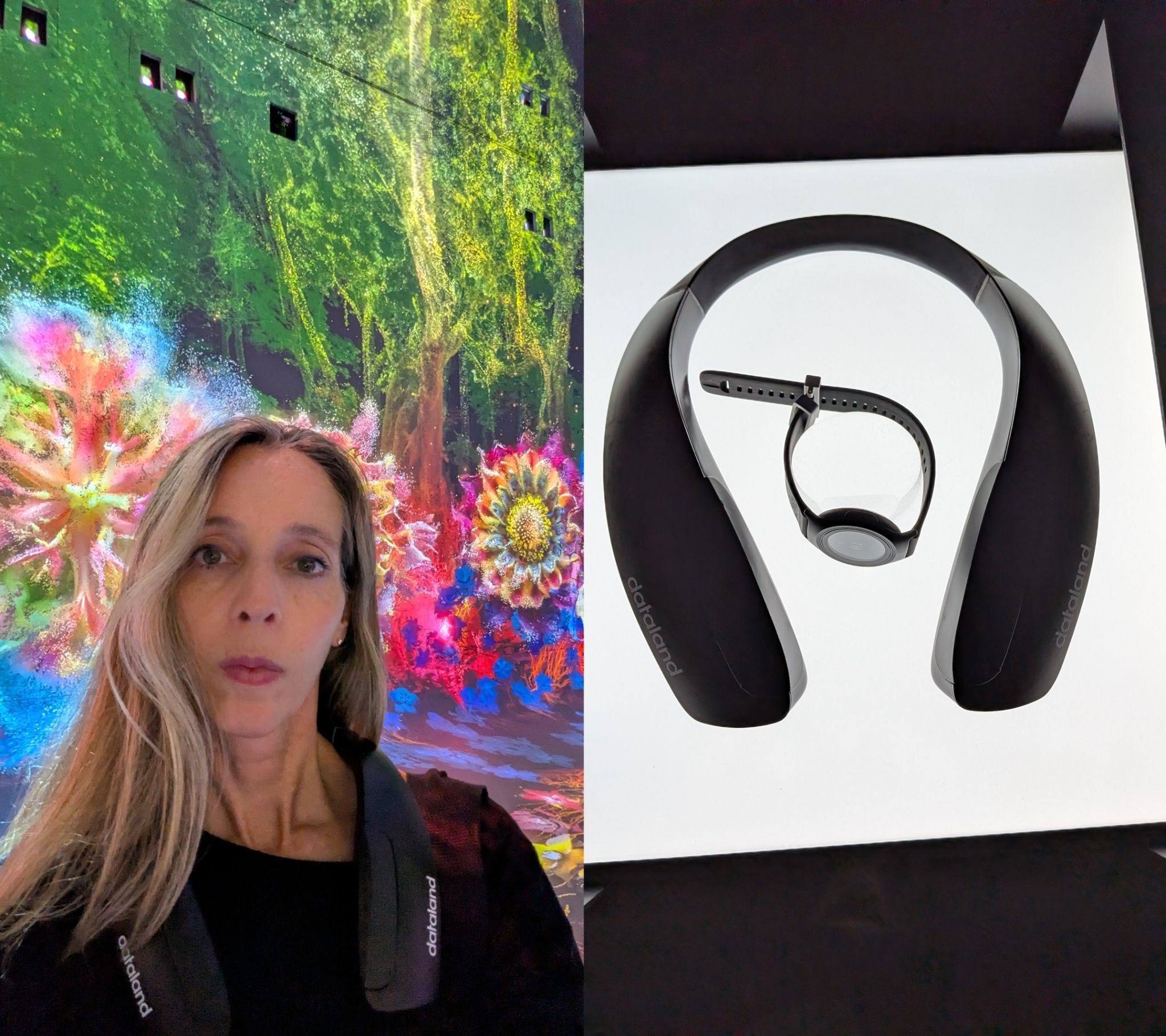
DATALAND presents biometric tracking as magical, pleasurable, and intimate. Surveillance is transformed into participation. Data extraction becomes personalized care. A device sprays perfume toward your face, almost as if distracting you from the fact that it is also measuring you.
The sensors disappear into the spectacle. Instead of asking why an artwork needs access to our physiological information, we are invited to feel flattered that the machine is interested in us.
DATALAND describes its interpretations of visitor data as poetic profiles generated from movement, duration, and physiological patterns. But is this really nothing more than a poetic gesture?
At the end of the visit, the logic becomes clearer. A sophisticated machine presents your data, compares your experience with those of other visitors, and offers to transform it into merchandise. You can purchase an $80 T-shirt printed with an image which is unique to your body and your visit.
So:
You pay to enter.
You provide the data.
The institution turns that data into a product.
Then you are invited to purchase it back.
It is difficult to imagine a more concentrated performance of surveillance capitalism. The visitor becomes audience, subject, raw material, consumer, and potential product all at once.
Perhaps the data is anonymous. Perhaps the T-shirt is fun. Perhaps most visitors will never think twice about any of this.
That is exactly what troubles me.
DATALAND does not merely use surveillance technologies. It aestheticizes them. It wraps them in color, music, scent, and the language of emotional connection. It teaches us that having our bodies measured is not something to question, but simply another feature of a premium experience.
The museum promises a relationship among humans, machines, and nature, but the nature I encountered felt strangely emptied of context. Rainforests appeared as enormous quantities of visual information. Flowers dissolved into particles. Animals became flowing abstractions. Ecological life was converted into patterns, pixels, fragrances, and data points.
The images were undeniably beautiful. But what was I supposed to do with that beauty?
Where was the urgency of ecological destruction? Where were the politics of extraction? Where were the difficult questions about the enormous technological infrastructures required to produce these frictionless machine dreams?
DATALAND promotes its use of permission-based datasets and lower-carbon computing infrastructure, and these efforts deserve recognition. But sustainability is not simply a technical calculation. It also requires thinking about scale, necessity, consumption, labor, power, and who benefits from the systems being built.
The overwhelming scale of DATALAND seems intended to communicate significance. More pixels. More projectors. More speakers. More data. Larger models. Larger images. An entire museum dedicated almost exclusively to the vision of one enormously successful artist.
It felt megalomaniac.
And it’s not because ambitious art is inherently wrong. But here, scale seemed to replace depth. Technical achievement overrode critical thinking. Immersion became more important than meaning.
When I stepped outside the AI museum, I found myself in front of another museum, The Broad. It was late, and The Broad was already closed. Signs advertised its current exhibition, Yoko Ono: Music of the Mind, a retrospective I had seen a few months earlier at the Museum of Contemporary Art Chicago.
Outside, however, The Broad’s olive trees had been transformed into Ono’s Wish Trees for Los Angeles. Visitors were invited to write wishes on small cards and attach them to the branches. Thousands of handwritten notes covered the trees.
I stepped into the grove and began reading.
People wished for peace, freedom, health, safety, kindness, happiness, love, and long lives. Some wishes were written in languages I could not read. Others were funny, personal, or intimate.
Technology also appeared in the wishes. Someone wrote, “I want a PS5.” Another wished for “world peace & an iPod nano.”
People wish for things.
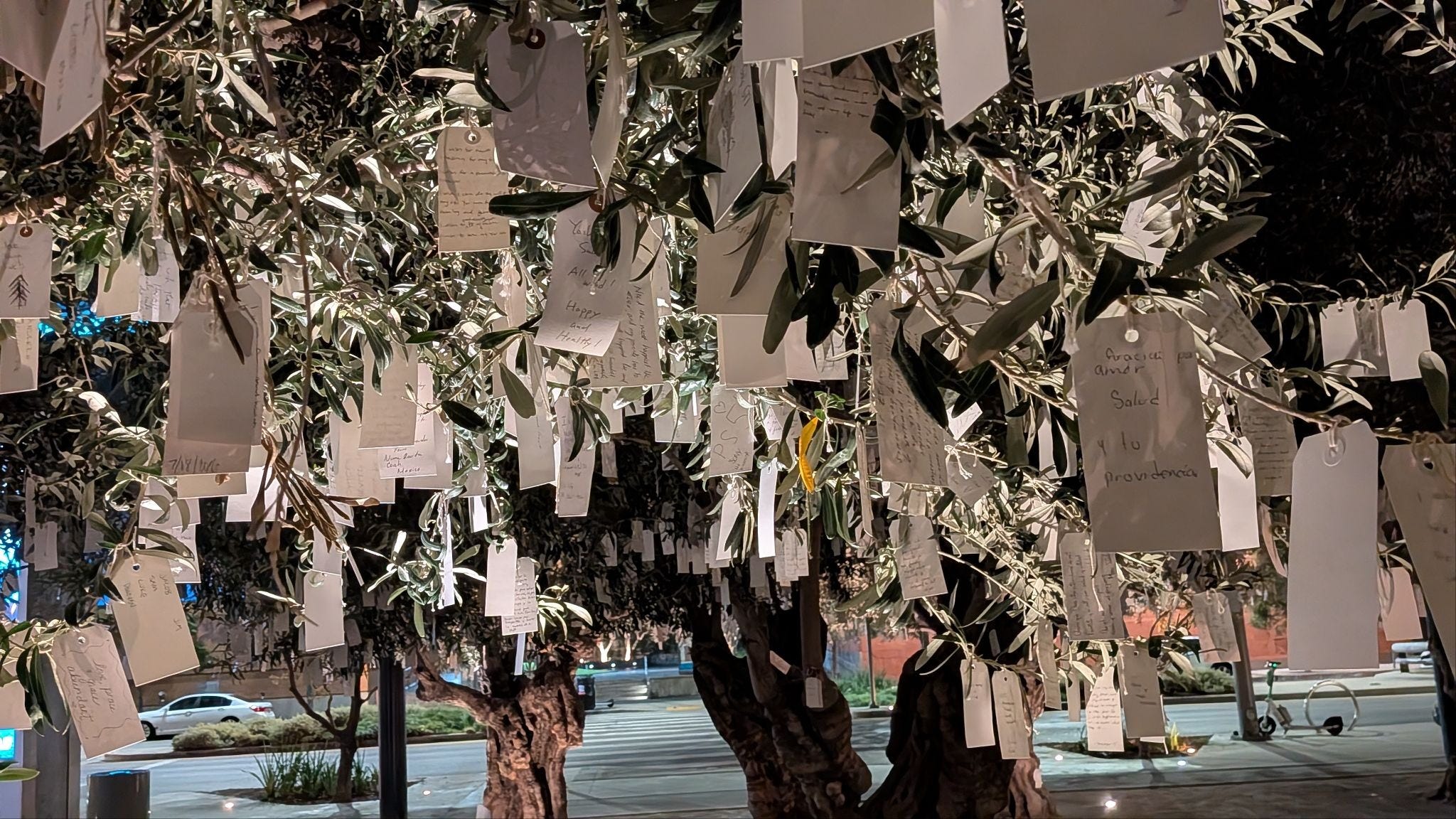
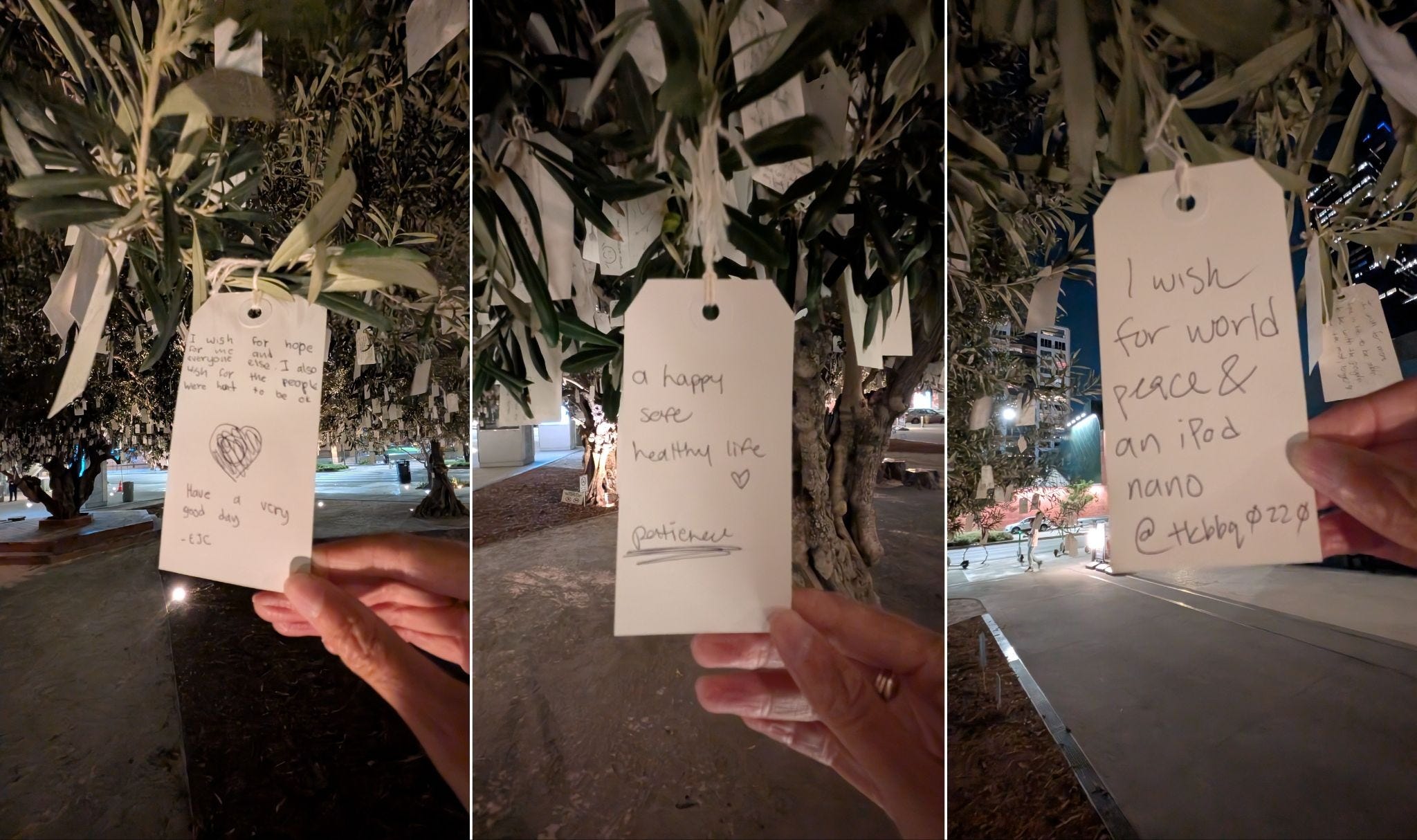
The cards were small, inexpensive, fragile, and sometimes difficult to read. There were no monumental screens, biometric sensors, or artificial fragrances. There was no attempt to convert the wishes into an emotional score or a purchasable product.
Yet walking among those trees felt genuinely immersive and emotionally engaging.
I could not help comparing the two experiences.
One artwork sensed people’s biometrics and offered them an $80 T-shirt made from their supposedly unique data. The other asked people to think of something, anything, they wished for, write it on a card, and hang it on a tree among thousands of other wishes.
I do not want to create an overly simple opposition between good conceptual art and bad technological art. Yoko Ono’s work also exists within the contemporary museum economy. The trees stood outside a major cultural institution surrounded by expensive real estate, luxury architecture, and corporate wealth.
And technology itself is not the problem. The problem is how we use it and how little we are encouraged to question that use.
Still, the comparison stayed with me.
The wishes accumulated into a collective portrait of vulnerability. They revealed what people feared losing and what they hoped the world might still provide. DATALAND’s measurements, in contrast, reduced embodied experience to data points.
If The Broad had been open when I was there, I probably would have taken a notecard and written my own wish:
“I wish the world’s first Museum of AI Arts was better than what it currently is.”
I really do think that DATALAND could become better.
I continued walking down Grand Avenue toward my hotel near the Los Angeles Convention Center. Along the way, I passed people sleeping on sidewalks, pushing carts, gathering their belongings, and trying to survive in one of the wealthiest and most technologically powerful cities in the world.
DATALAND did not create this inequality, and no single artwork is responsible for solving homelessness. But art does not exist outside the street it occupies. A museum presenting a triumphant vision of AI cannot be separated from the social world waiting immediately beyond its doors.
As I walked, I kept thinking about relationships between people. I thought about what we are asking AI to do, what we are allowing it to measure, and what kinds of futures we are constructing around it.
Can we really use AI to understand one another more deeply?
Can we use it to distribute care, knowledge, safety, and possibility?
Or are we using it to make extraction feel intimate, consumption feel meaningful, and surveillance feel beautiful?
I wanted DATALAND to complicate my understanding of artificial intelligence. Instead, it seemed to reproduce many of the conditions that most concern me: greed, exploitation, environmental excess, technological solutionism, and the quiet conversion of human life into marketable information.
And for what?
To surround us with colorful images disconnected from the contexts they supposedly represent? To release synthetic rainforest scents into our nostrils while a biosensor measures the response of our skin? To reassure us that AI is magical, benevolent, and emotionally attentive, as long as we can afford the ticket?
I cannot quite tell people not to visit DATALAND. It is a remarkable technical production, and anyone interested in immersive media, AI art, projection, or experiential design will probably want to see it.
So I guess, go see it, if you can afford the ticket.
But do not leave your critical faculties at the entrance.
Ask why the sensors are necessary.
Ask what the measurements contribute to the art.
Ask who owns the technological infrastructure.
Ask why participation so often means surrendering information.
Ask what kind of relationship with AI is being rehearsed through your body.
Do not be afraid to be a critical asshole.
As for me, I will not rush back to DATALAND.
I will only return if and when it offers something more than bigger screens, richer data, personalized products, and increasingly seamless forms of surveillance. AI art is capable of beauty, but beauty is not enough.
At a moment when artificial intelligence is reorganizing labor, authorship, intimacy, education, politics, attention, and the ways we relate to one another, we need art that does more than mesmerize us.
We need art that helps us think.
They commissioned 4 emerging artist to install work there I believe. Curious what they will do with the facility.