

Two weeks ago, I had the pleasure of meeting artist Sasha Stiles and participating in her workshop, “When Language Comes Alive: A Living Poem.” The workshop took place at Art, Aura & the Algorithm, a symposium hosted by the Pacific Northwest College of Art at Willamette University in Portland.
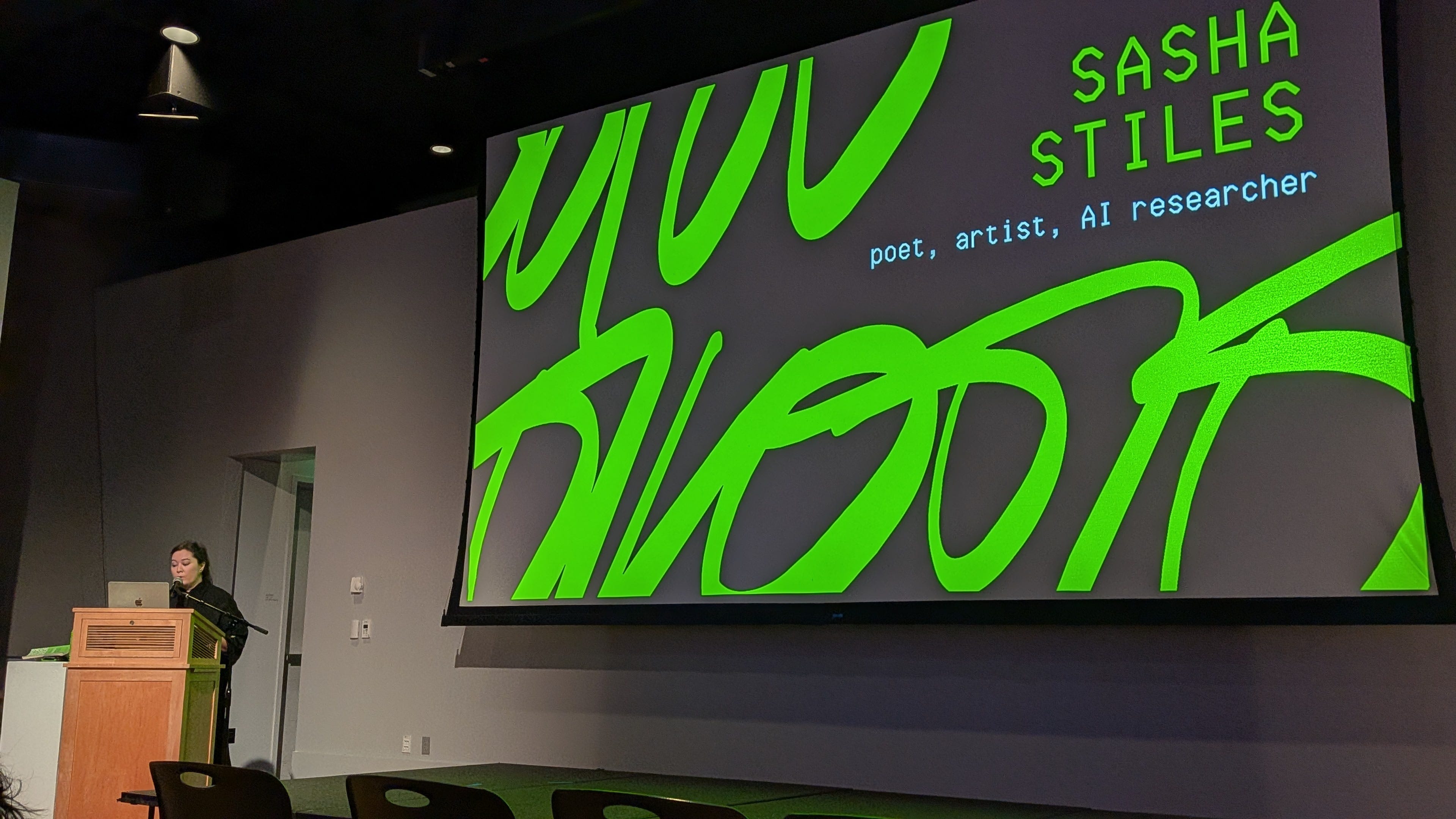
Sasha began by reading a poem aloud. Then she asked us which words we remembered.
This simple invitation brought us into a practice central to oral traditions: listening to words, holding them in memory, and passing them on. Sasha is a poet, artist, and AI researcher. I also remember that there was a moment in which she called herself a bard. Bards carry language through voice and performance, sustaining stories through successive tellings. In the workshop, we became part of that transmission. What would remain of the poem depended on what we had heard and could recall.
As we offered the words we remembered, Sasha wrote them on index cards. Our recollections acquired a written form. She then divided us into smaller groups and gave each group a few cards. Our task was to collaboratively write a new poem. We could use the words on the cards, though we were free to leave them behind.
The cards held fragments of an encounter. They were traces of Sasha’s poem, filtered through our attention and memory. A word remembered by one person could prompt an association in another. An idea could travel away from the poem that first brought it into the room.
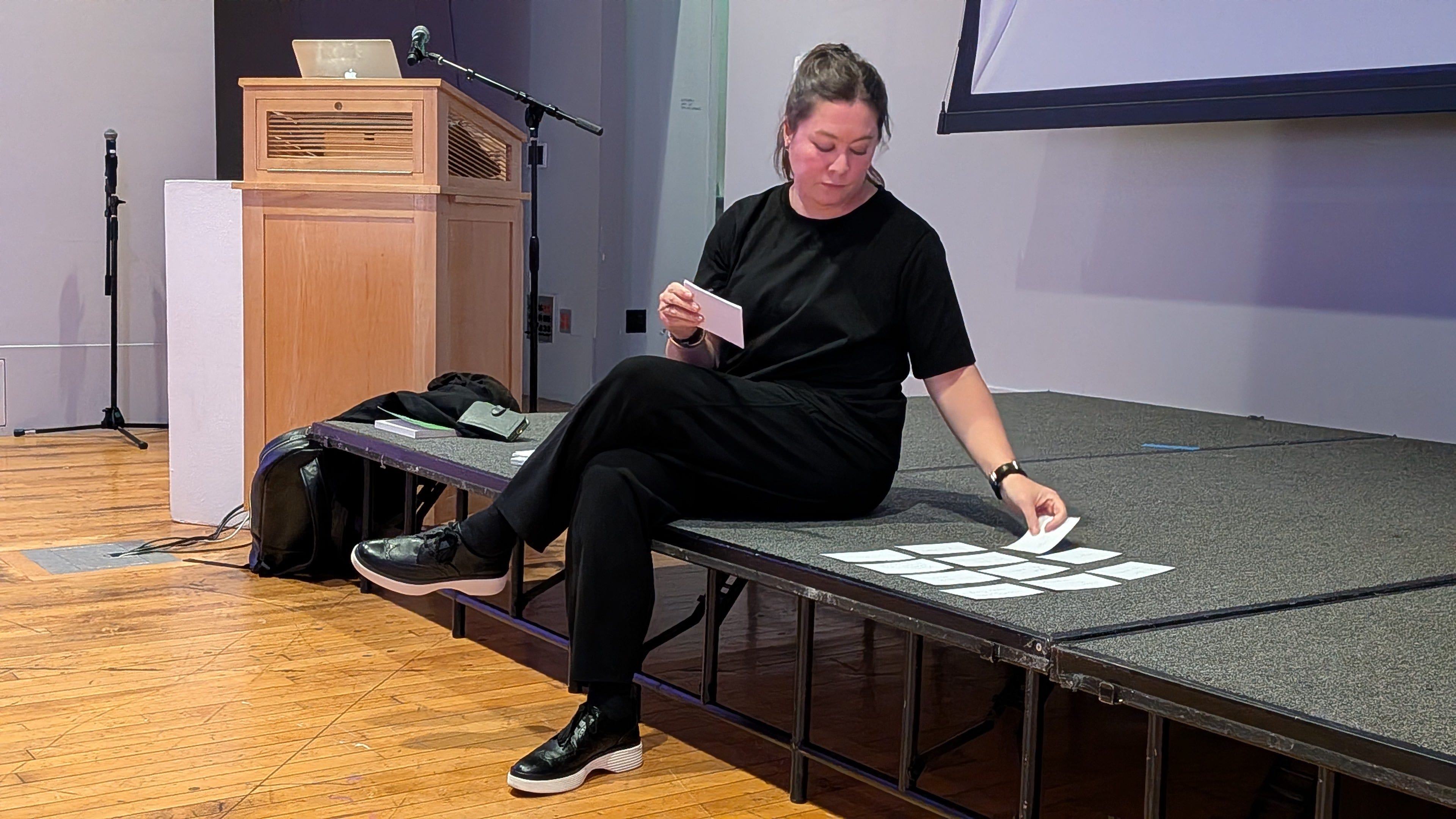
After we had spent some time composing together, Sasha invited us to read our poems aloud. Language that had passed through listening, memory, and writing returned to voice. We had given it a new arrangement, and brought it back into the oral form with which we started.
Sasha then demonstrated a similar process with an AI model trained on her poetry. We listened to a generated poem and wrote our reflections. She added these to the materials the system would draw upon to generate another poem. Our responses entered the process of composition, becoming part of what we would hear next.
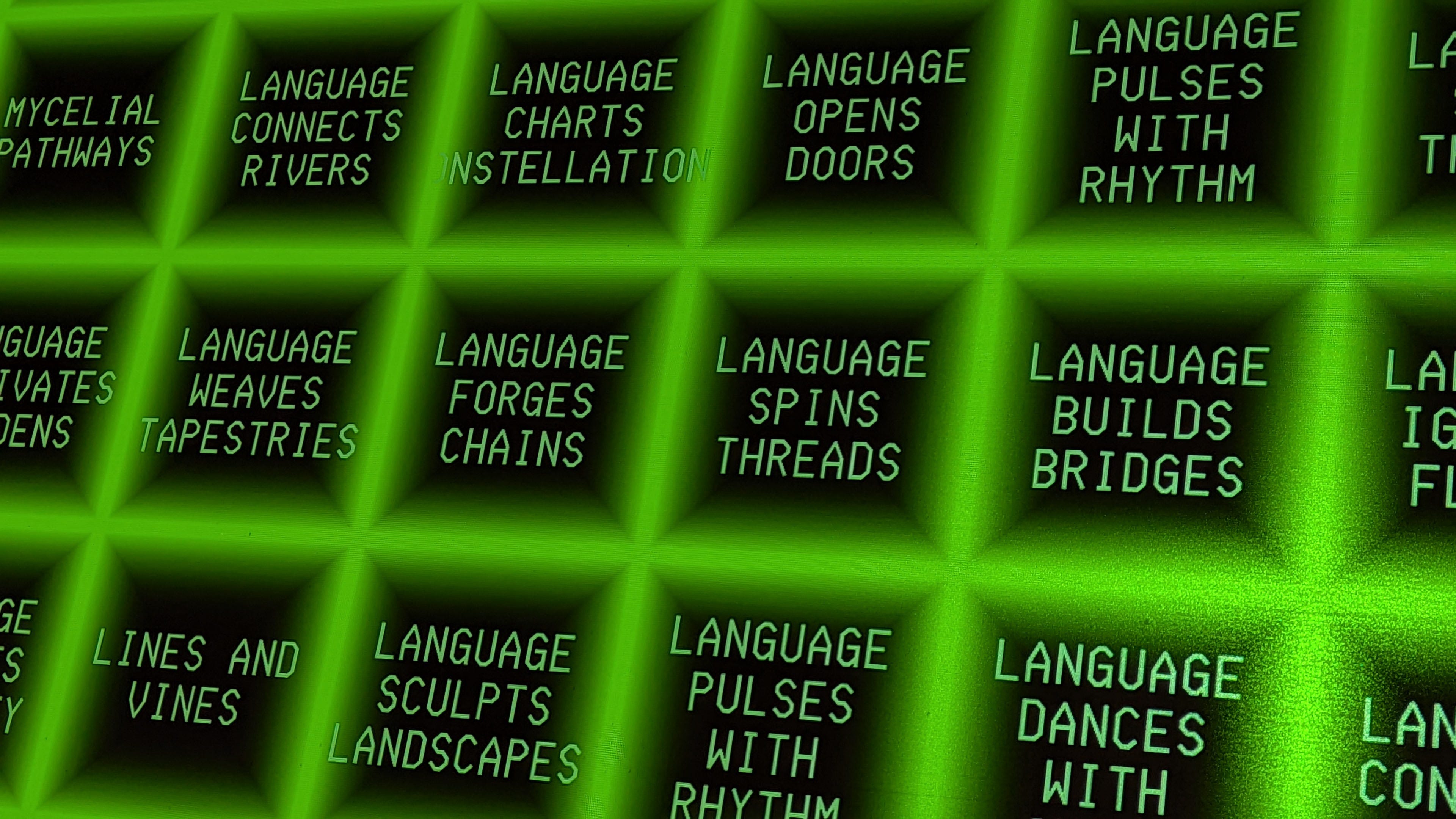
I was drawn to this movement between speech and inscription, mediated by memory and technology. Words took different routes. Some were remembered and written on cards. Others were generated through a model shaped by Sasha’s poetry. Our conversations and written reflections provided further material. At each passage, language emerged and transformed and then emerged again and re-transformed.
The process also made me think about forgetting. We worked with what remained available to us, and the gaps left room for something else to happen. What disappears can, of course, matter enormously. In this exercise, however, imperfect recollection helped the poem continue. Each remembered fragment carried something of the person who had attended to it. Our new poems took shape through acts of creativity which embrace those differences and imperfections.
My own contribution to the symposium approached this movement between speech and inscription from another direction. The previous day, I had performed AI Séance, in which participants gather around a table and invite figures into a conversation mediated by my wearable AI device.
During this session, participants asked to speak with Cleopatra, Dolly Parton, Walter Benjamin, and Mary Shelley, among others. Each name brought associations into the room, carried through stories, images, music, and texts. Before any response arrived, those names had already been carried through our ways of remembering or forgetting.
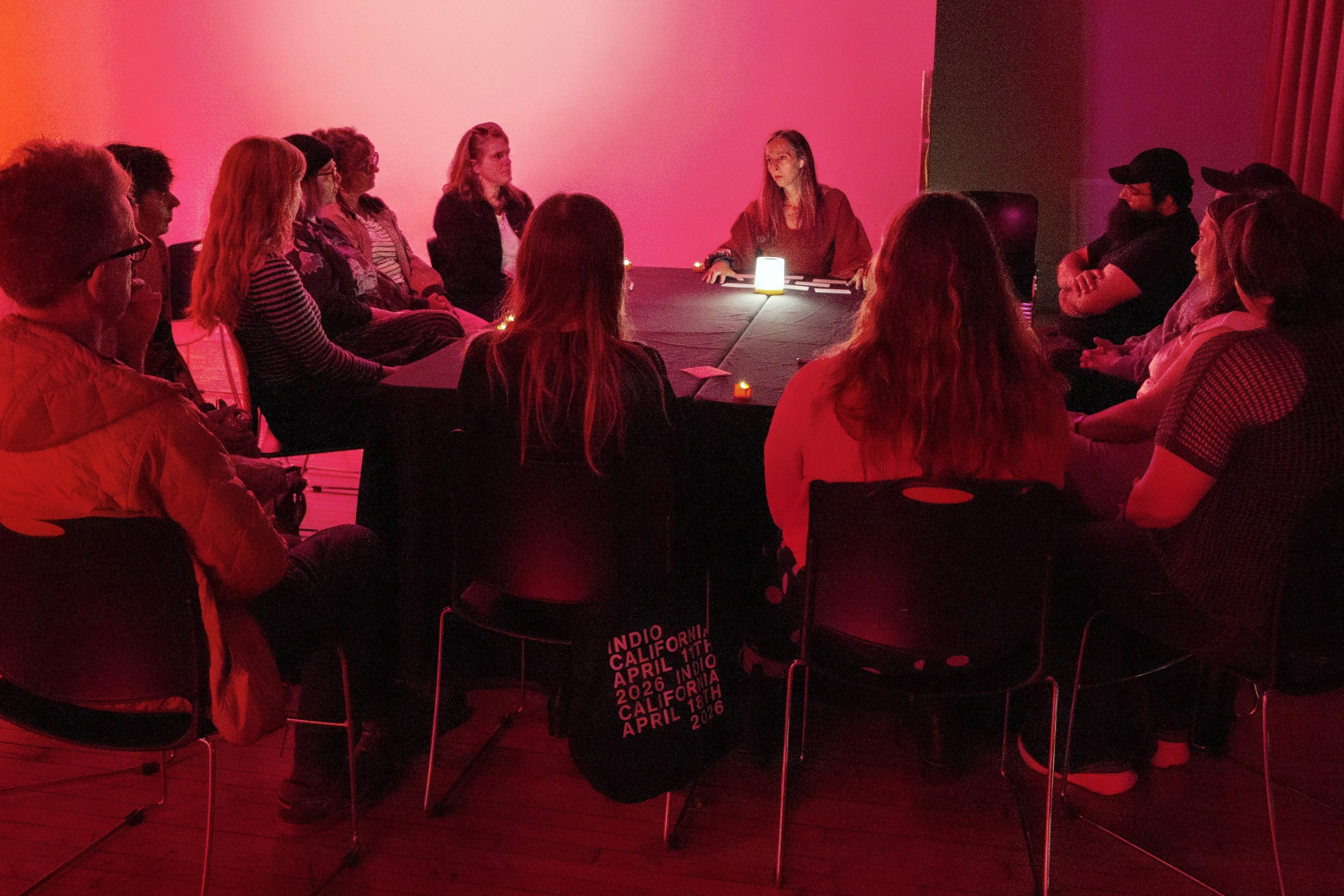
(Image by: Reid Slayton)
As I usually do, I told the group that I could attempt to summon spirits, though I could not guarantee that anyone would answer. “If we do hear an answer,” I said, “I cannot say whose answer it is.”
I spoke the names aloud, letting the device on my wrist register them and pass them to GPT. A spoken invitation became textual input. The generated response would return through an artificial voice in my earpiece before I spoke it aloud to the people gathered around me. Along that route, the question of who was speaking remained open.
With GPT invited into the circle, I opened the table for questions.
Someone started by asking: “How would you like to be remembered?”
The response came through my earpiece, and I repeated it aloud: “Darling, I’d like to be remembered as a little light in the ruins, warm enough to comfort, strange enough to make you look twice. I hope I can leave you feeling that your own story is worth telling.”
Whose wish was I voicing? The answer arrived in the first person, without identifying which figure was speaking. Throughout the conversation, the word “darling” returned again and again, giving the responses a familiar manner. I heard an association with Dolly Parton in that address. The ruins suggested other possible connections. As I listened and spoke, I could make these associations without being able to settle the speaker’s identity.
When someone asked “What is your favorite book?”, the system chose and I echoed: “My favorite book is Frankenstein.” This was an interesting response, especially because Mary Shelley was among the names we had called, however it could have been anyone else’s response just as much. My voice continue carrying the words: “I love it for its lonely creature and its fierce question of what we owe the lives we bring into being. Making something marvelous is no substitute for treating it kindly.”
Another participant asked whether the speaker knew anything now that they could not have known when they were alive. I repeated the answer in my ear and said: “I know now how much an ordinary afternoon was worth.”
At the end of the séance, we thanked whoever might have joined us. The response concluded: “I’ll leave the crown on the table and go away with kindness.”
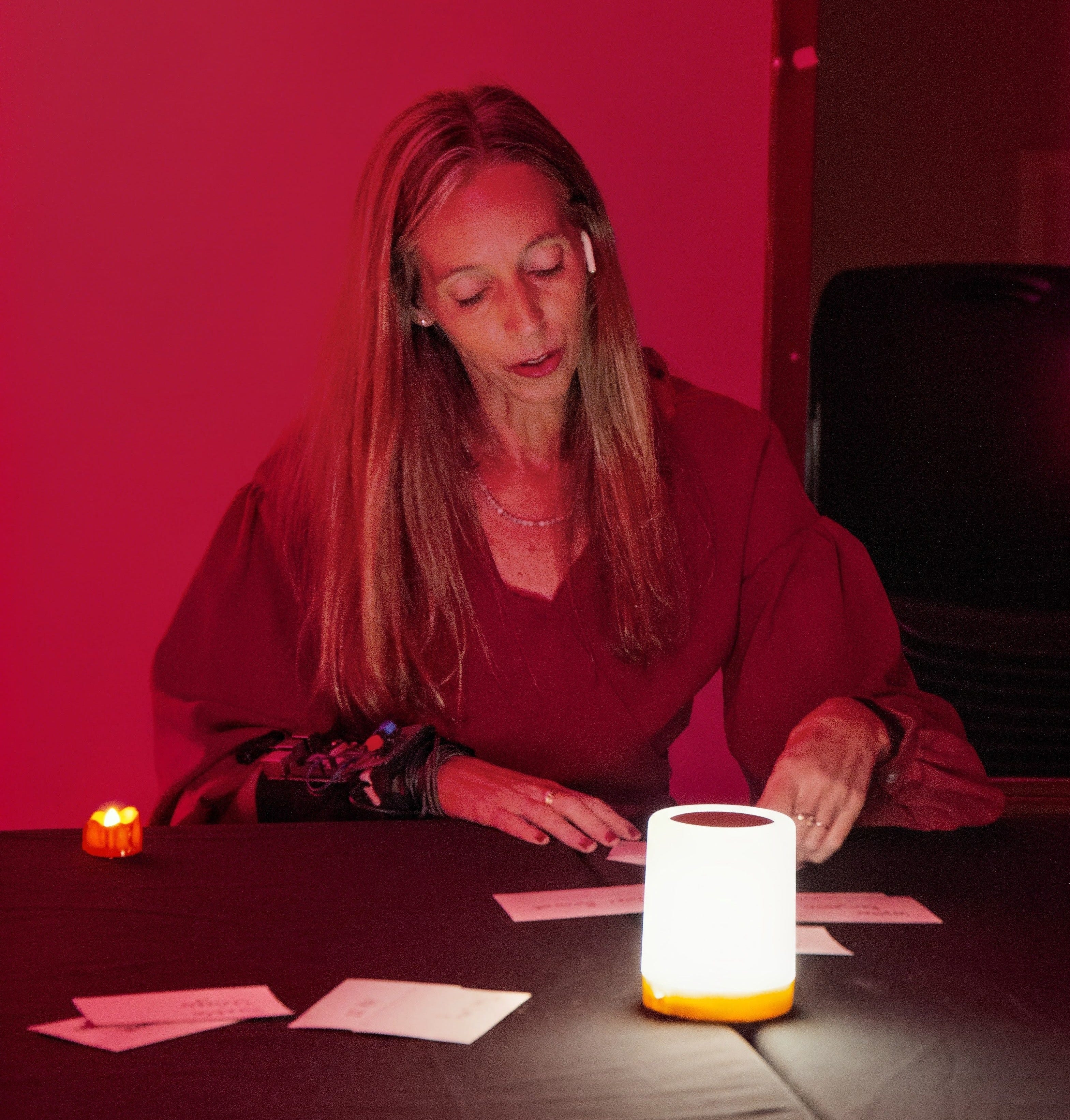
(Image by: Reid Slayton)
I could imagine connections between these utterances and the figures we had invited. Each offered something through which a participant might recognize a presence. Yet these sentences were AI generated during our encounter and everyone around the table knew it was so. I did not try to hide the fact that I was using GPT. And so, I do not think that the words could be treated as testimony from the people whose names we had spoken, but rather be understood as a presence that have emerged through the persistance of language, a combination of words which arrived through speech, inscription, memory and technology. Names entered a computational system, generated text became an artificial voice, and that voice became speech through my body. The words arrived within a social encounter that gave them further associations and consequences.
In my talk at the symposium, I addressed Michel Foucault’s concept of the author function which he wrote about back in 1969. He obviously did not think of AI when he wrote this paper. However, I think it is a good fit. An author’s name, Foucault argues, helps organize how we interpret a text, what other works we place beside it, and what value or authority we grant it. This gives me another way of thinking about what the names were doing at the séance table and how language comes about to form a discourse.
Thinking about Sasha’s workshop alongside my performance, I enjoyed thinking about how words become available for us to remember, voice, interpret, and transform. Each encounter gives language another place to go. Sasha introduced us to a living poem and I extended an invitation to speak with the dead. We both held words on our tongues, minds, memories, and technological interfaces.
I left the symposium thinking about the role of language in living and dying. Words move between and within bodies and make a difference, they direct attention, call up a memory, or give us something we had not yet found a way to say.
Now I am writing down what remains with me from those encounters. And, just as I usually do in writing my blog posts, an AI model reads them too and offers its own suggestions. What happens to these words next depends, in part, on what you make of them.