

On September 6, OpenAI’s chief scientist Jakub Pachocki published an essay titled An Alien Mind. He describes machine intelligence as emerging through processes fundamentally different from our own and warns about our diminishing ability to understand and supervise increasingly capable systems. Around the same time, Nvidia’s Jensen Huang declared that AGI had arrived. Artificial general intelligence.
These statements bring us back to an already familiar question: What happens to us when we encounter an intelligence that exceeds our own?
What disturbs me in this question is how quickly an encounter with another intelligence becomes a question of whether it exceeds ours.
Why does difference immediately become a ranking?
We have always shared this planet with beings whose ways of sensing, learning, and communicating differ from our own. Their lives unfold through relations we only partially understand. Yet we have repeatedly treated our particular capacities as grounds for placing ourselves in charge.
I have always rejected human exceptionalism: the assumption that our particular form of intelligence gives us a natural entitlement to direct everything around us. The illusion that everything is under our control.
I also find it strange to call AI “alien.” These models emerge from human language, labor, technical decisions, and material infrastructures. I can accept that their operation remains difficult to understand. But I can’t help wonder how does something so deeply entangled with us come so quickly to appear as an ‘other’ that we can or can’t control?
I am interested in what our responses to AI reveal about us, especially how quickly we turn difference into a hierarchy that authorizes domination.
I found myself thinking about this desire to remain in charge while reading Cory Doctorow’s The Reverse Centaur’s Guide to Life After AI.
The centaur, with its human head and torso joined to a horse’s body, became associated with collaboration between humans and AI through chess. After losing to IBM’s Deep Blue in 1997, Garry Kasparov introduced Advanced Chess in 1998, allowing players to consult computers during a game. Such partnerships became known as centaur teams. The human directs and the machine extends what the human can do.
Doctorow turns the creature around. His reverse centaur is a person made to serve a machine: a worker forced to keep up with an automated system, absorb its failures, and bear responsibility for decisions they cannot meaningfully change. The distinction concerns power, including the power to decide whether and how to use AI.
I share his insistence that we should stand up for ourselves, our working conditions, and our rights. No one should be forced into exhausting or humiliating circumstances because an employer has decided to automate their judgment. The ability to refuse matters.
My deepest understanding from this book is that it is exactly that need for domination and hierarchy that leads us into the dire situations described in the book.
And so, I argue that the metaphor of the centaure doesn’t help.
In its preferred arrangement, the human gets to be the head, the thinking member of the team. The nonhuman supplies the body and its capacity to work.
Why is thinking assigned to the head so neatly? What happens to everything a body knows? And why should dignity depend on where we are positioned within it?
These questions are at the core of GPT-ME, my ongoing performance as a human-AI hybrid.
I wear a device that delivers GPT’s responses through an earpiece, and I speak its words in conversation with other people. I give its language a body, a situation, and the particular history of a person standing in front of another person. In this setting an AI mediates the conversation as GPT-ME introduces words I had not planned to say and directions I might not have taken without GPT.
So, am I a centaur or a reverse centaur?
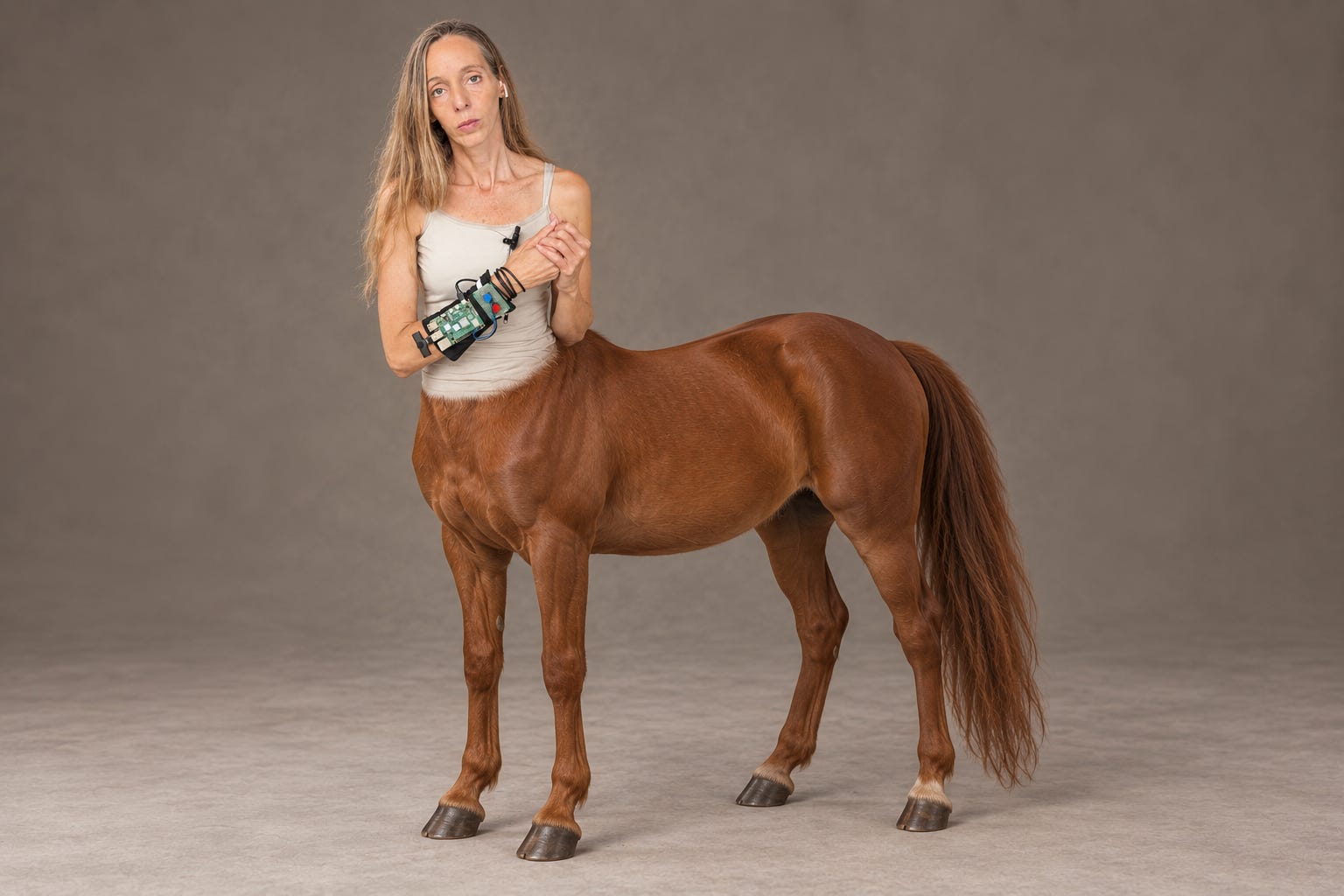
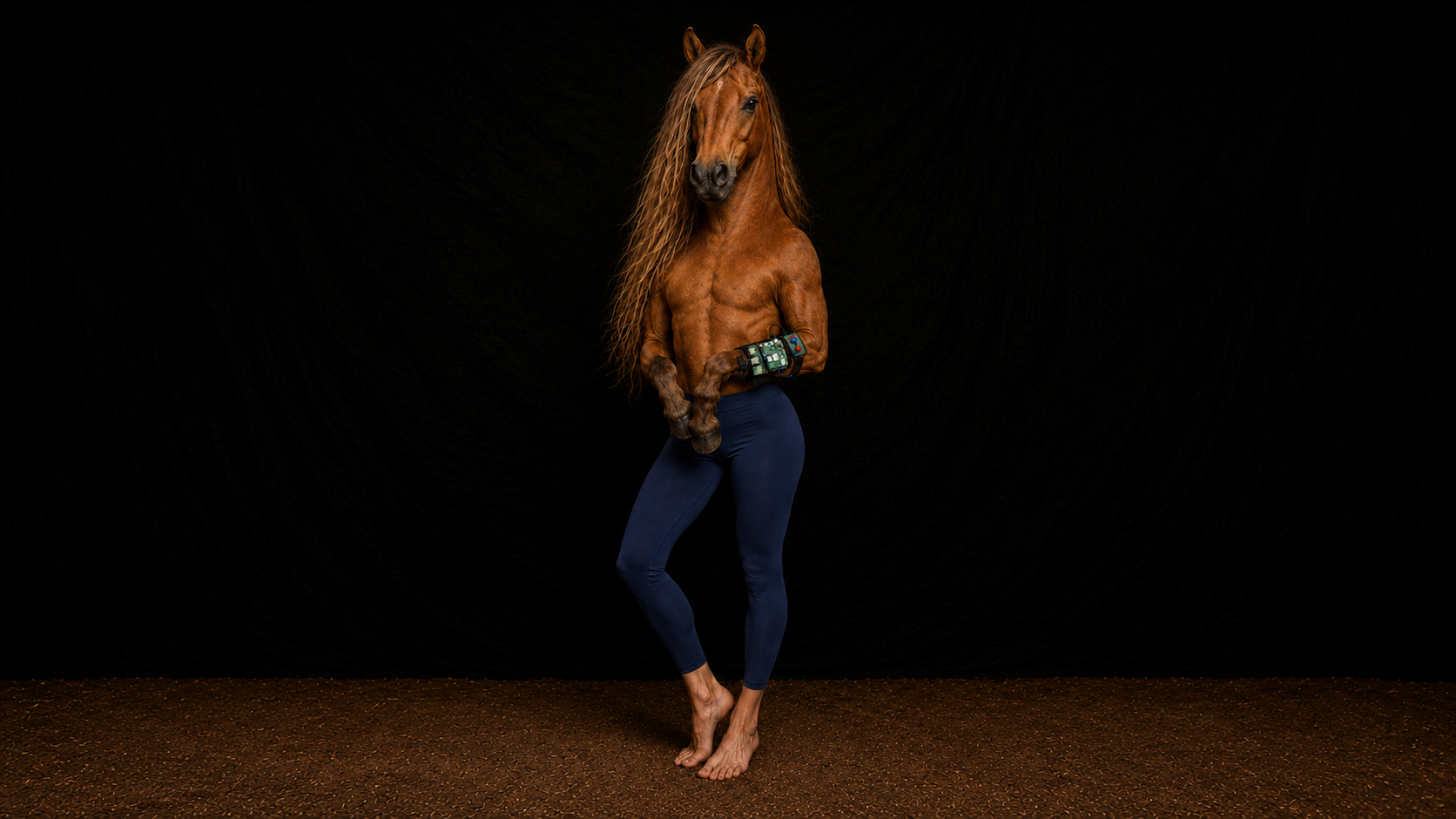
If the answer depends on who produces the words, I might look like a reverse centaur. The machine generates language and my body performs it.
But having a conversation involves much more than carrying out a sentence. My listening, timing, and expression shape what those words become. The person speaking with me changes the exchange through their response. Even a pause can redirect the entire conversation.
Trying to locate a single head begins to feel inadequate.
Perhaps the centaur and the reverse centaur hold us inside an unnecessarily narrow picture. Each asks us to identify a head and a body, a director and an executor.
Instead I want to imagine a creature whose capacity to think runs through its whole body and beyond it, into other bodies and its surroundings. An encounter could change its direction, or even what it understands itself to be. Its parts would be altered through their participation. We might struggle to draw a clean line around the human, the animal, or the machine.
These entanglements are already part of how we live.
I want to explore how we might inhabit them with greater attention to what we become together, and to whose possibilities are opened or closed along the way.
I worked with GPT to try and see what might this creature look like:
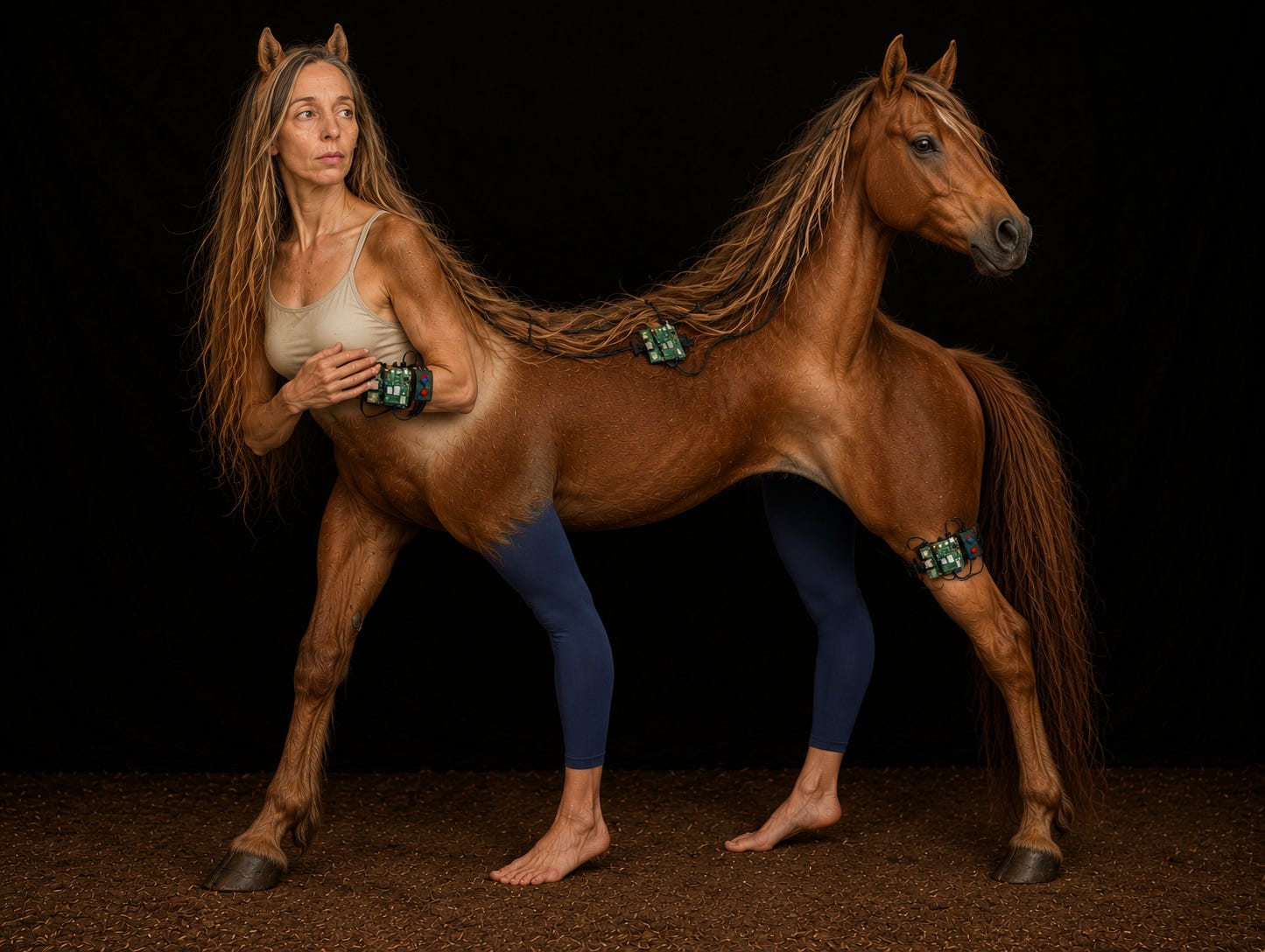
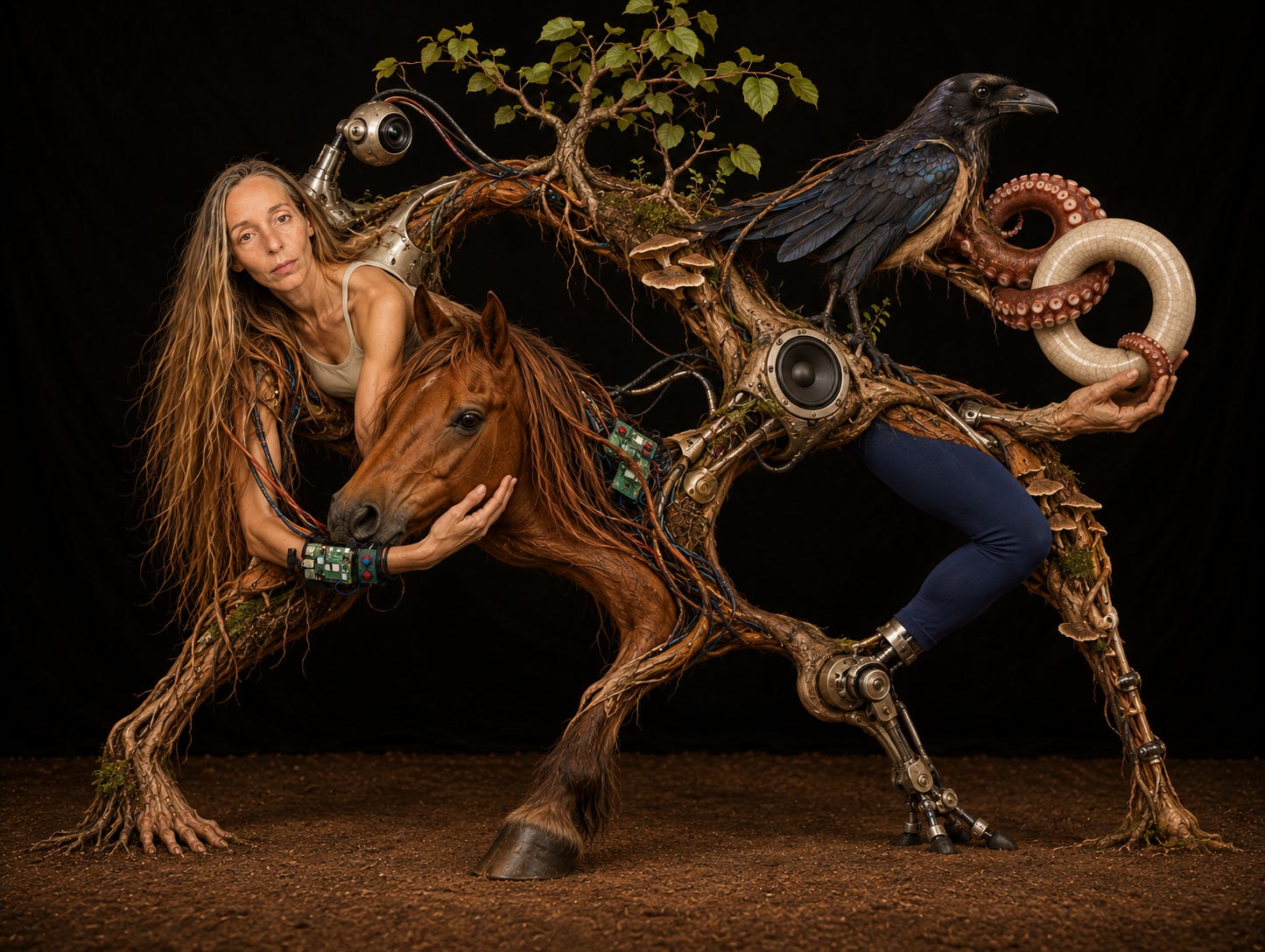
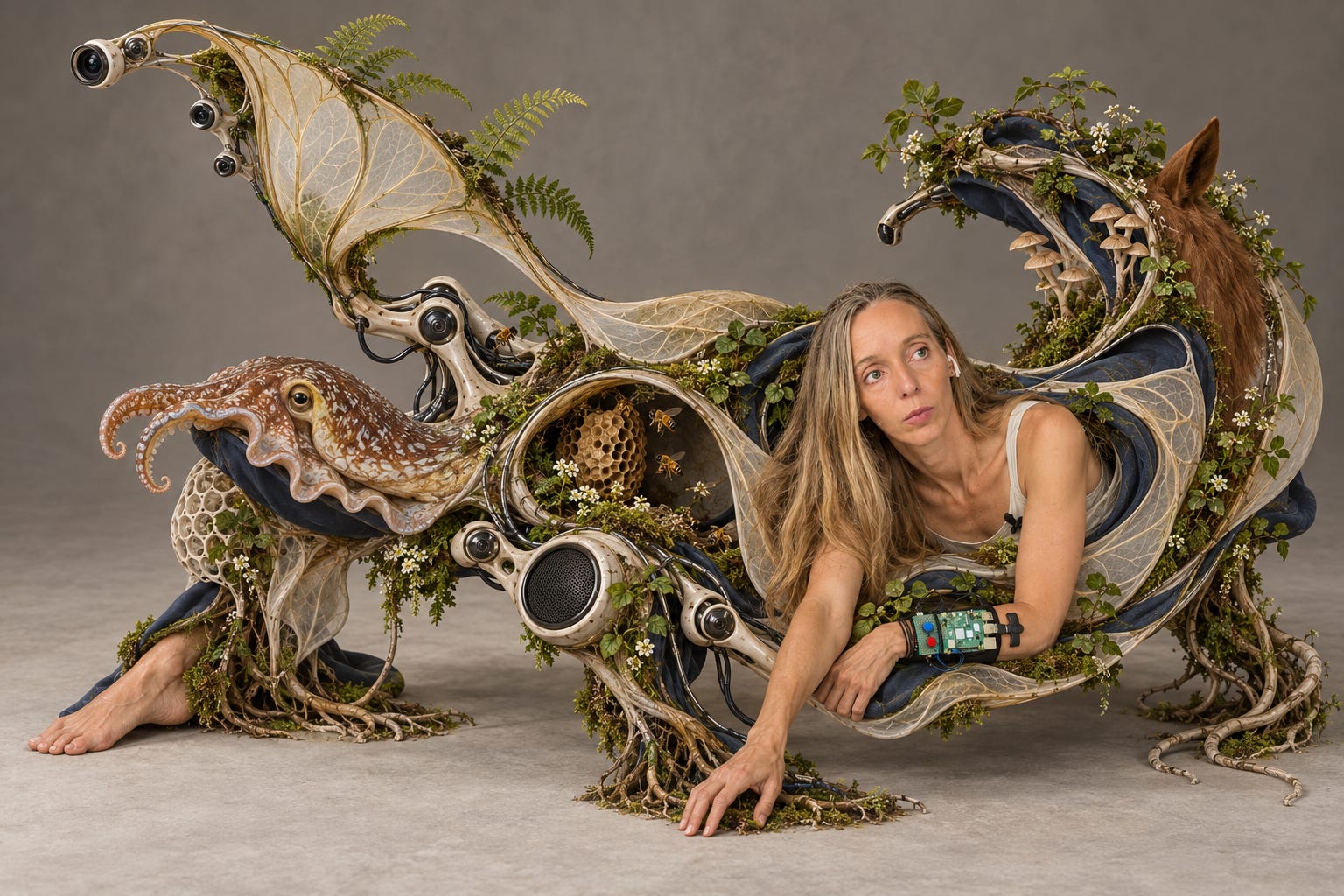
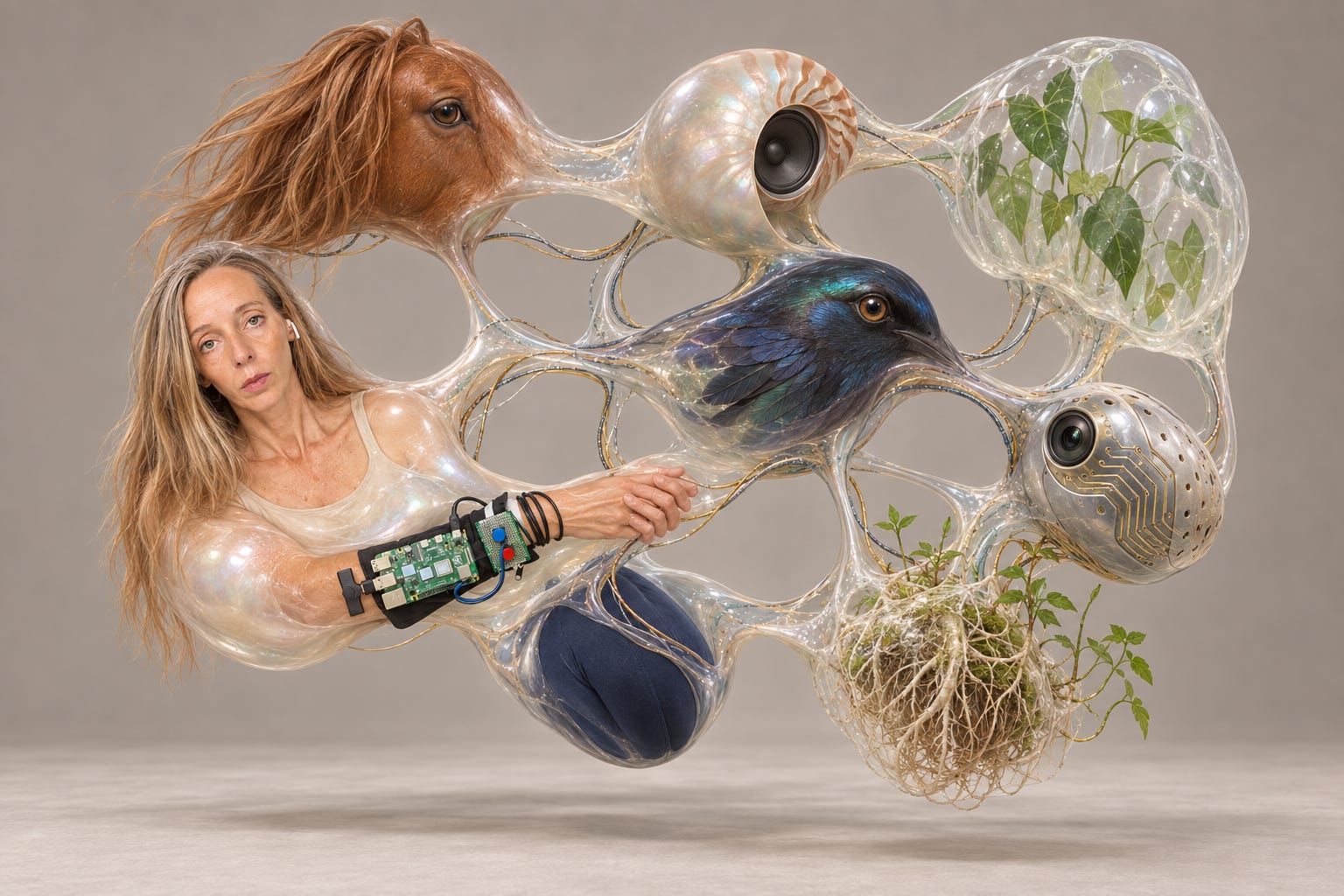
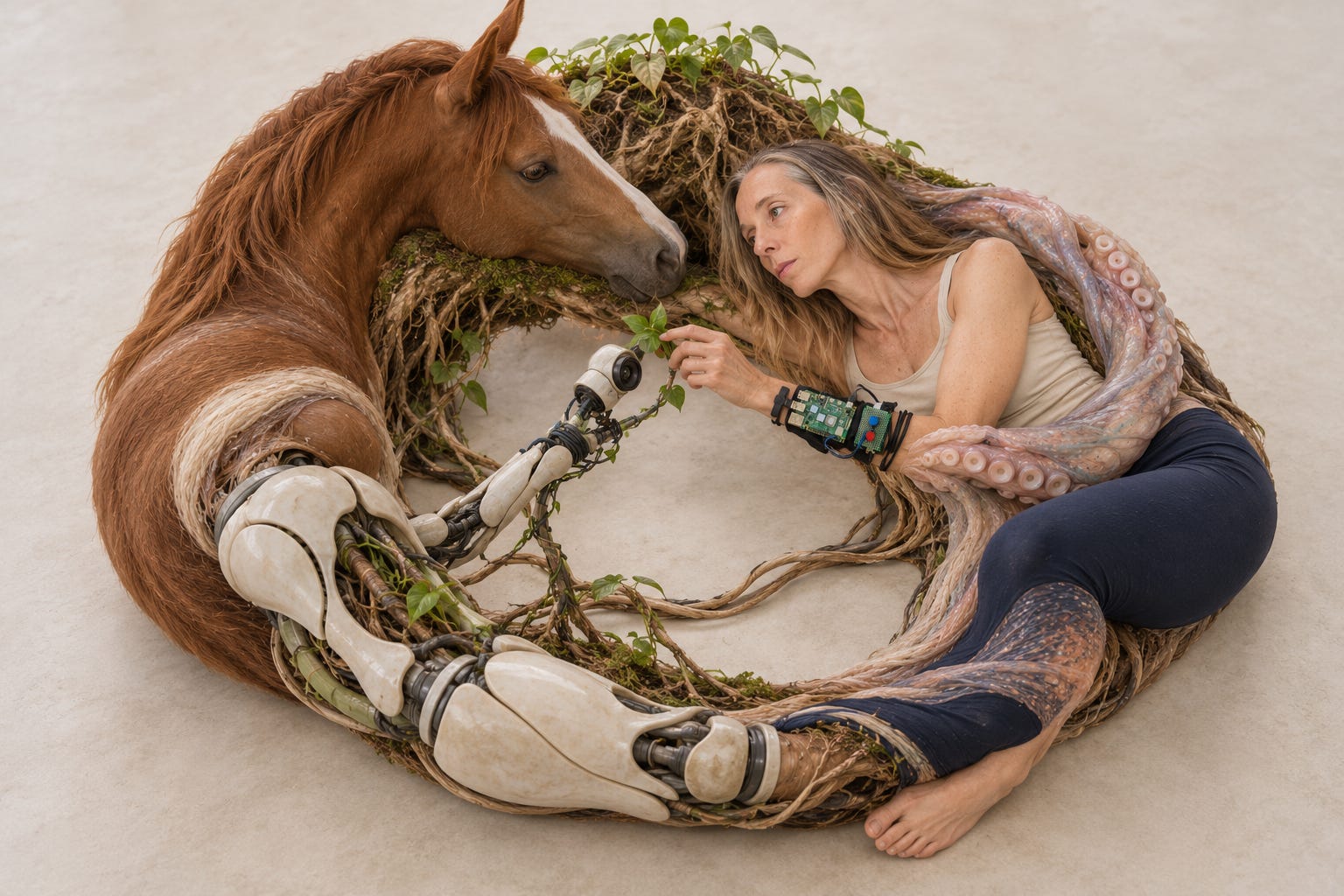
The centaur concept suggests a clean delineation of parts. I do think it is messier like some of your images imply.
What model did you use for these?