

Usually, attending a conference means moving constantly between talks, exhibitions, demonstrations, and chance encounters. It means making impossible choices between simultaneous events while suspecting that something important is always happening somewhere else.
This year, I stayed almost entirely in one place.
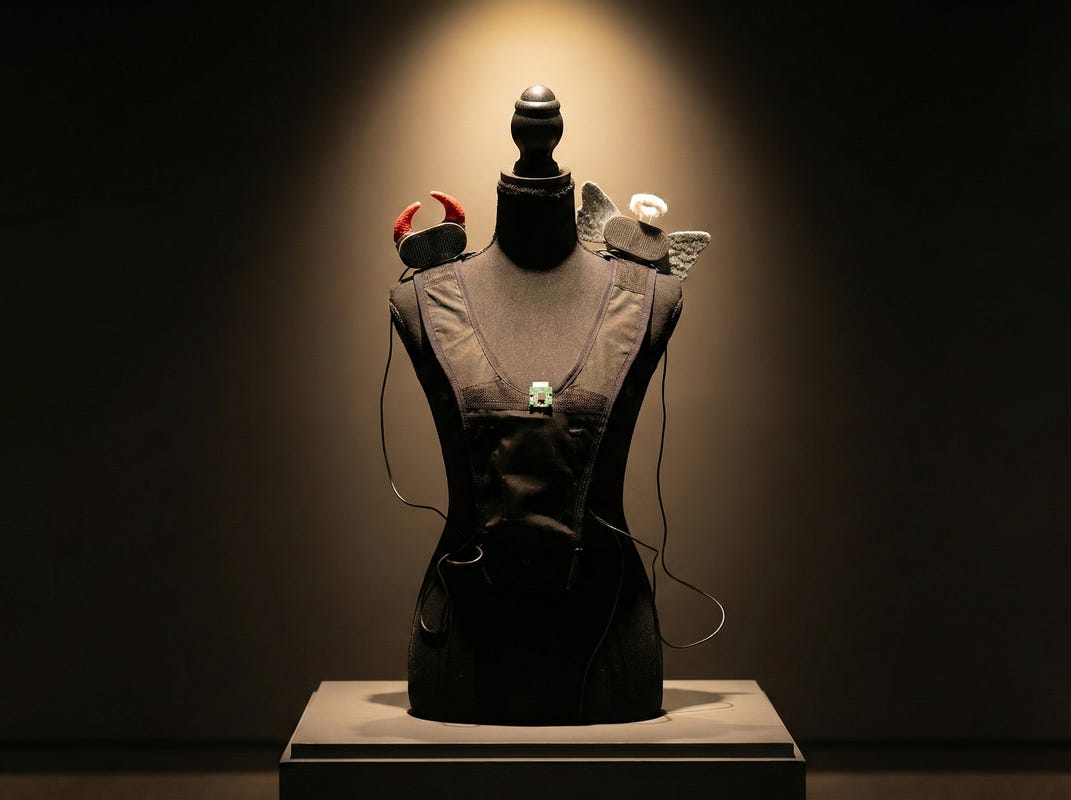
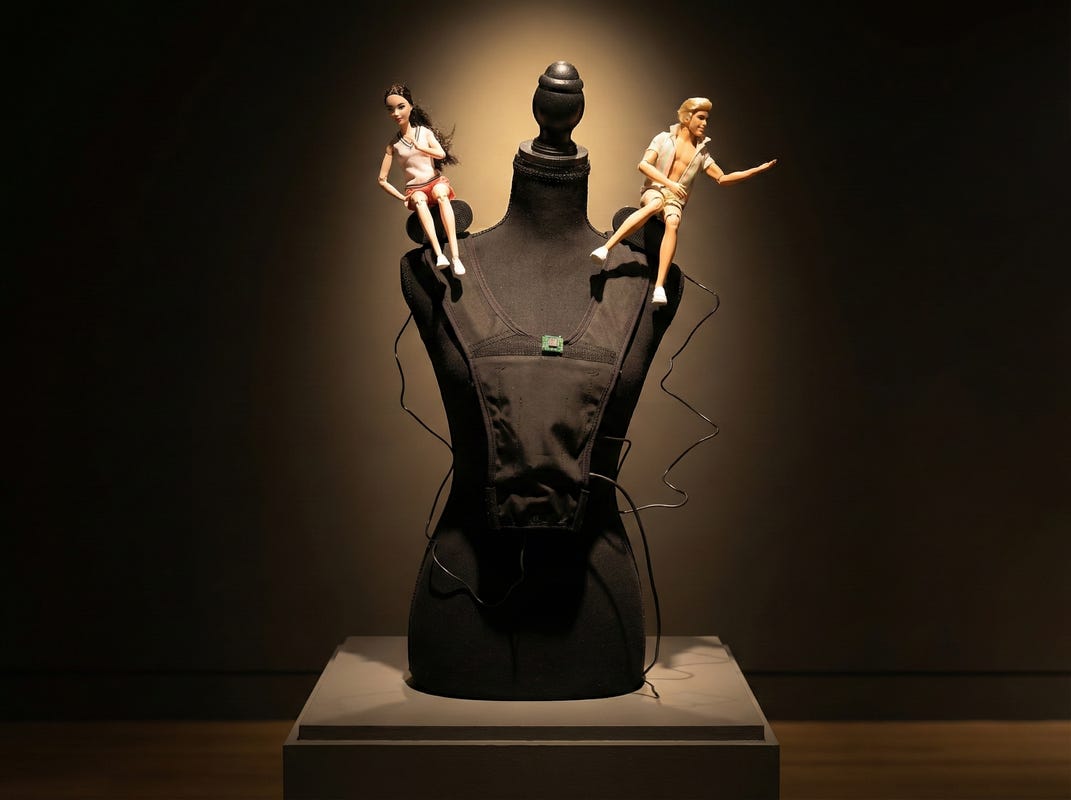
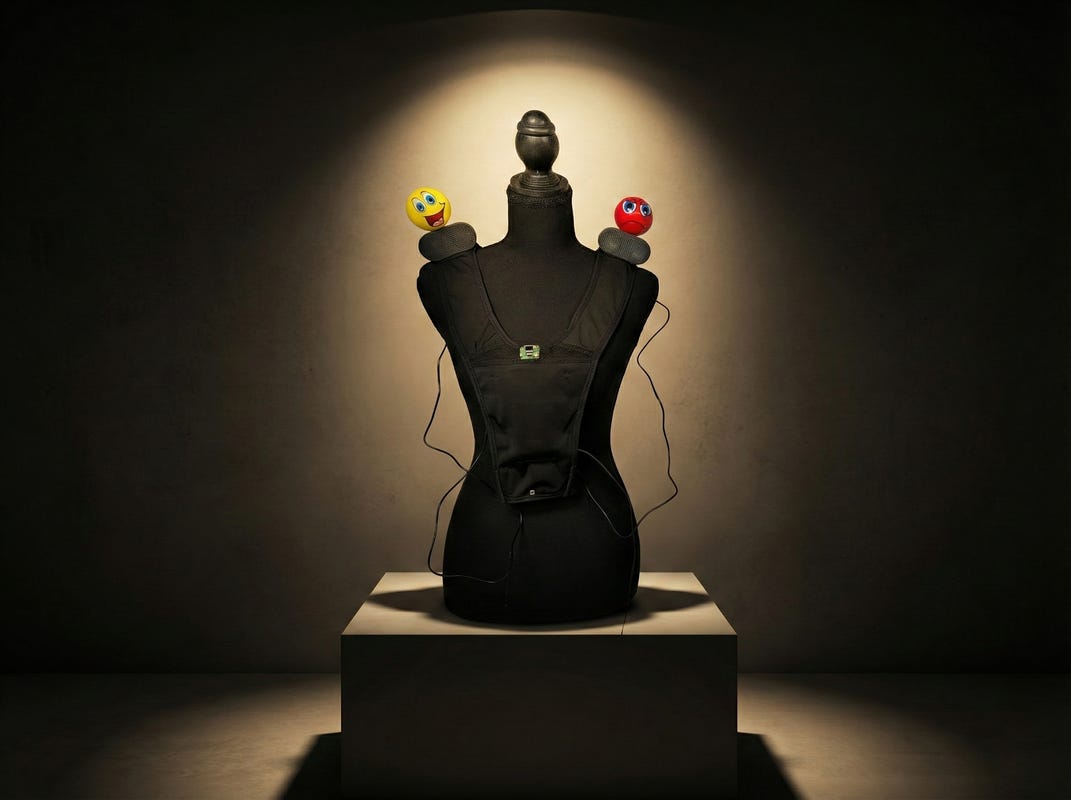
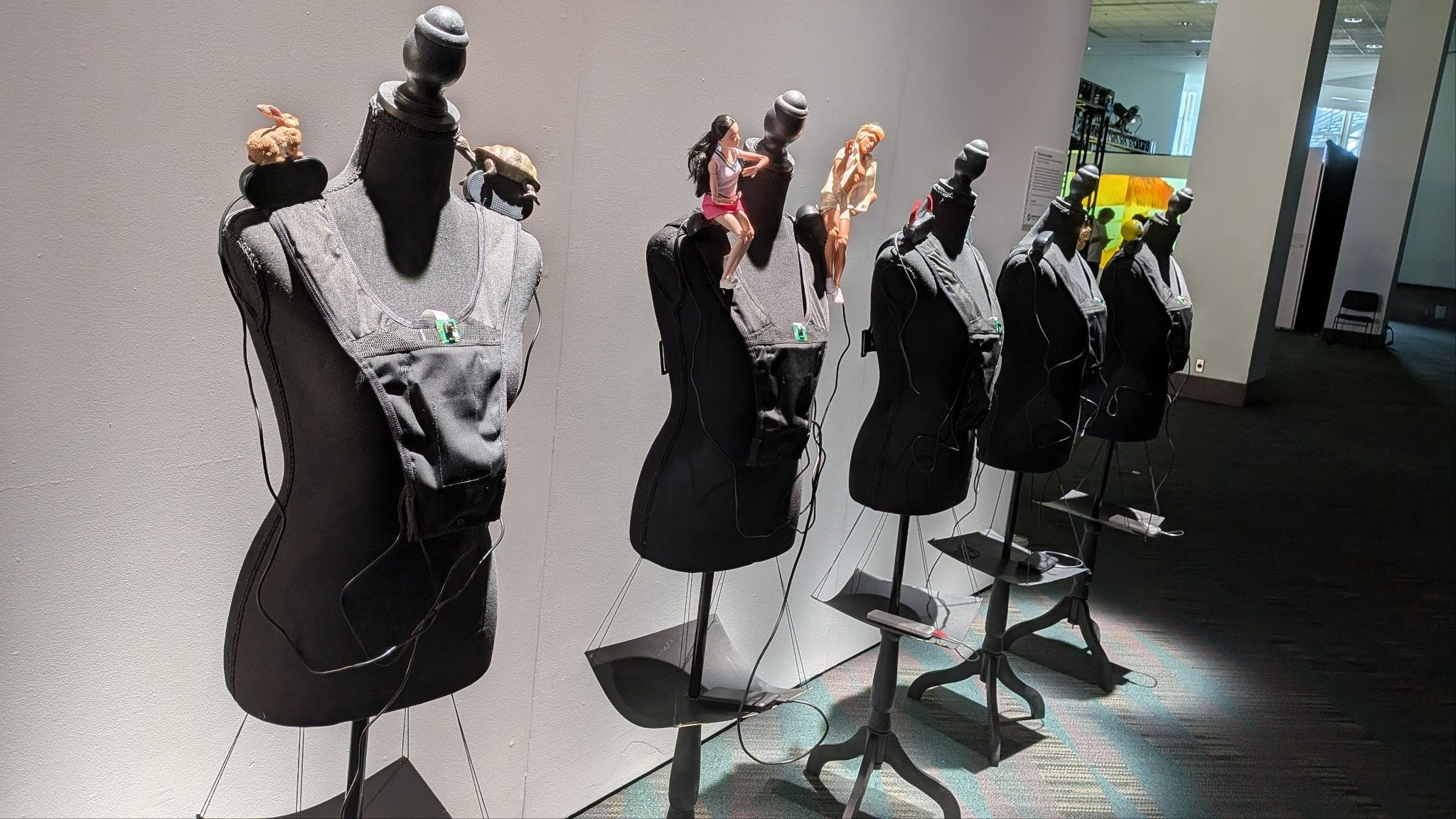
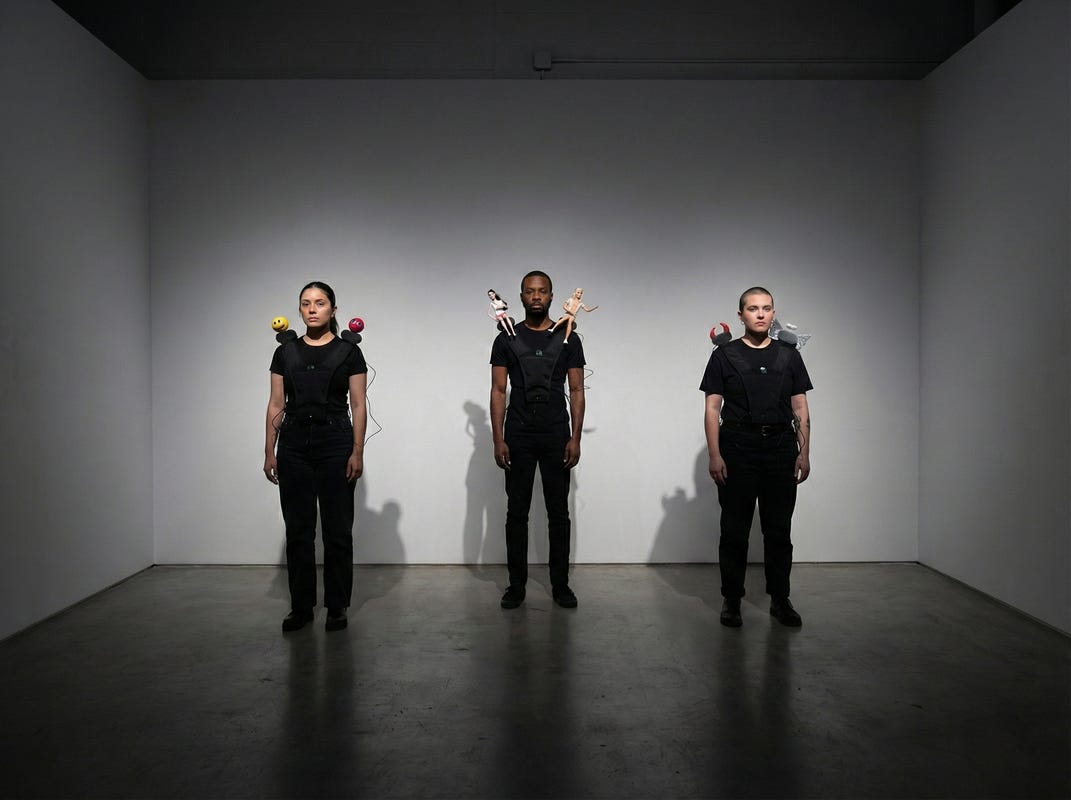
I was presenting Stuck in the Middle at the SIGGRAPH Art Gallery. The piece is a participatory wearable AI performance composed of five vests. Each carries two AI agents on the wearer’s shoulders, embodying a familiar binary: Angel and Devil, Happy and Sad, Feminine and Masculine, Rich and Poor, or Fast and Slow.
A camera mounted on the wearer’s chest captures whatever is in front of them. One agent interprets the scene and generates an instruction, advice, or opinion. The opposing agent immediately contradicts it. Both speak aloud, leaving the participant physically and conceptually positioned between them.
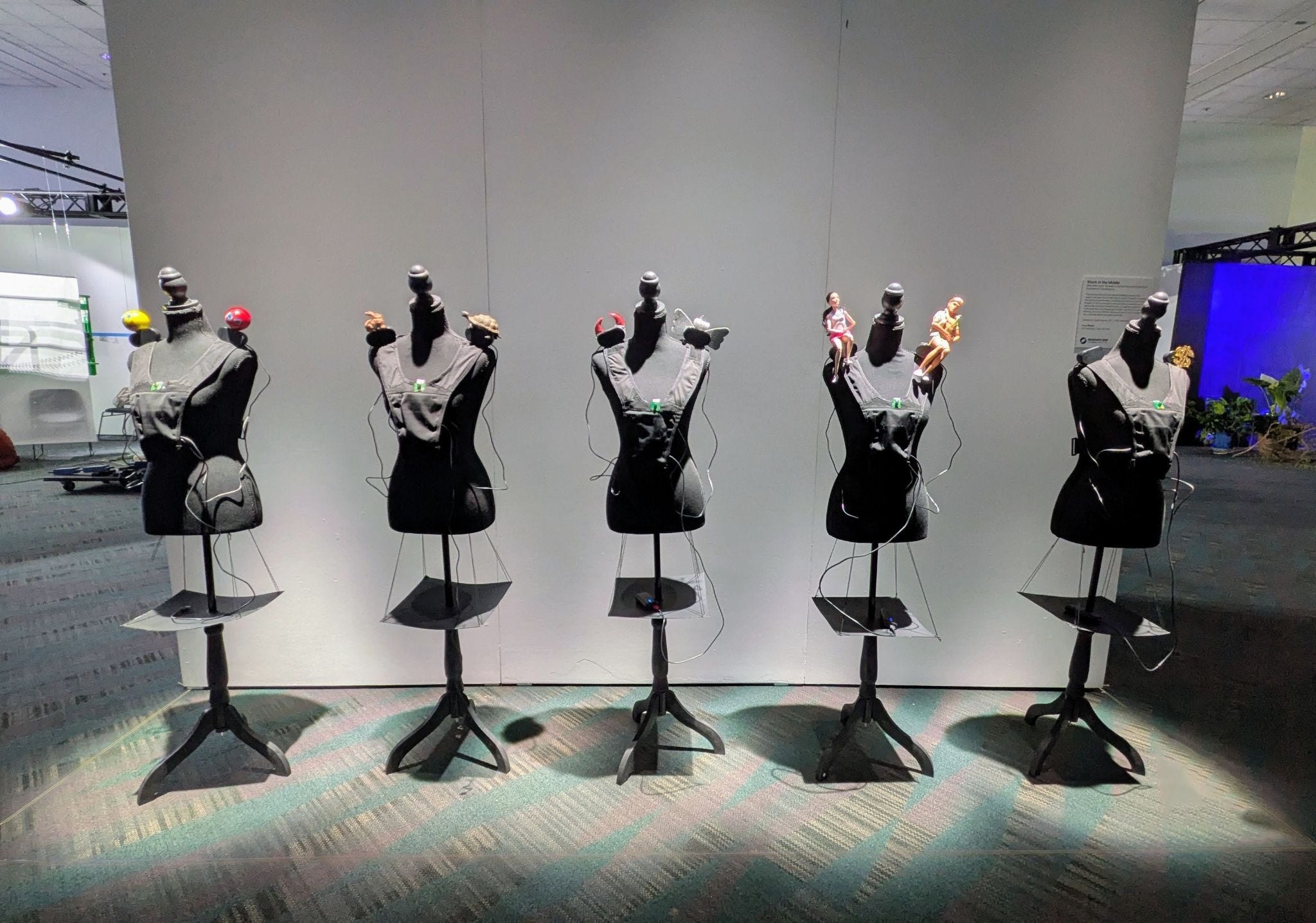
Throughout the conference, I helped visitors choose a vest, placed the agents on their shoulders, and showed them how to activate the system.
Then I sent them away.
Some remained near the gallery, testing the agents on artworks and friends. Others disappeared into the enormous conference, carrying the agents into technical demonstrations, exhibition booths, crowded corridors, networking events, and conversations with strangers.
Eventually, they came back.
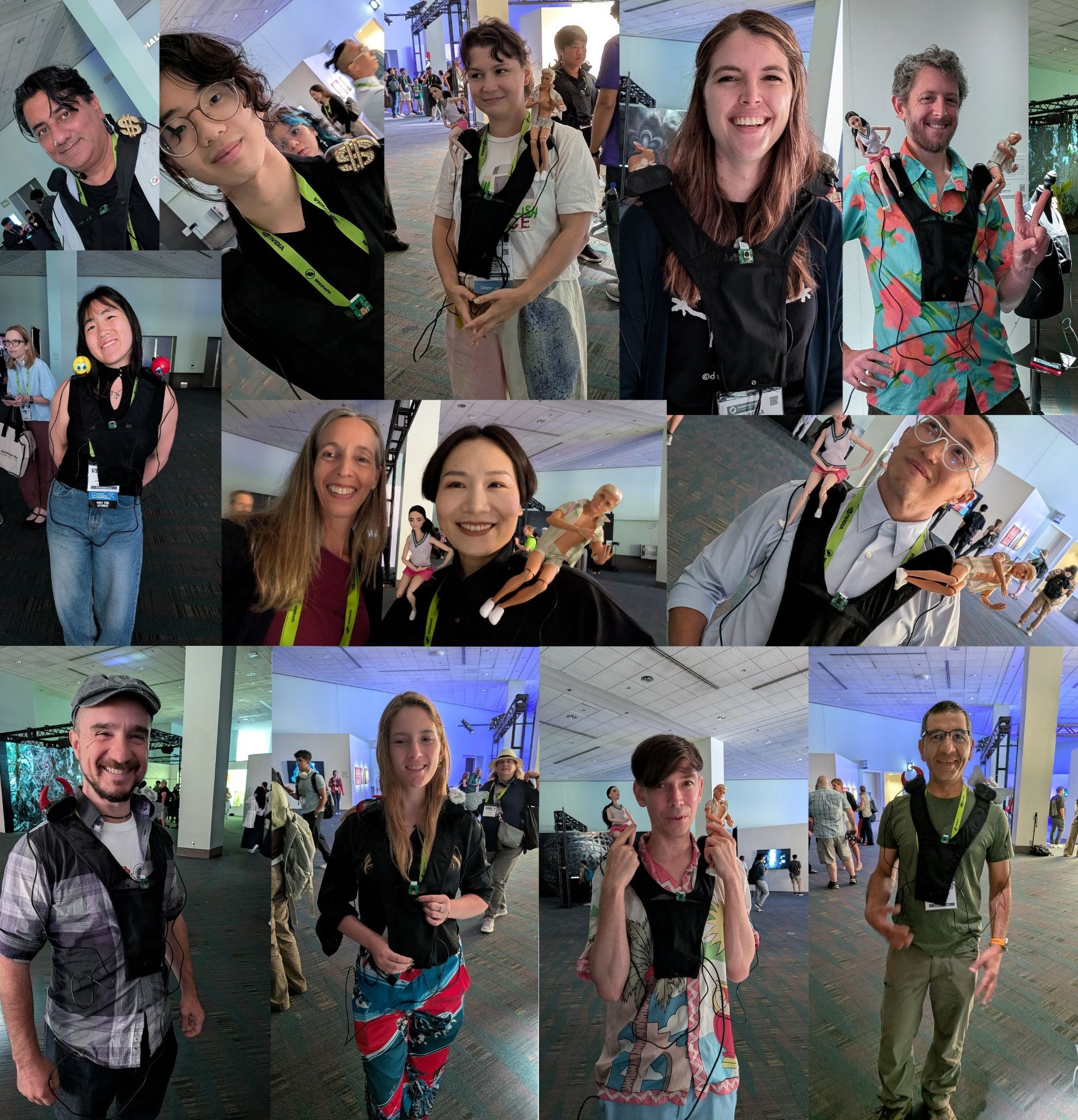
I helped them remove the vest and asked the question that became central to my experience of SIGGRAPH 2026: What happened?
People returned describing arguments the AI agents held in real-time while sitting on their shoulders. They talked about instructions they had obeyed or ignored, moments when an agent made them laugh or embarrassed them, and statements that felt unexpectedly accurate. Some aligned strongly with one voice and became irritated by the other. Some laughed at both. Some deliberately positioned themselves in unusual situations to test how the agents would interpret them. Others returned newly aware of how quickly an AI system could reduce a complicated situation to a stereotypical position.
The agents did not merely describe what they saw. They told the wearer what to do.
That distinction is important. The work is not primarily about whether AI vision can correctly identify an object. It is about the movement from perception to instruction. A scene is captured, interpreted, and translated into a demand. One agent always starts by urging the wearer: introduce yourself, disrupt the situation, join the crowd, disappear from it, take control, find shelter, move faster, slow down.
The second agent contradicts the first, but contradiction does not necessarily produce freedom. Sometimes it simply creates more pressure. Instead of one authoritative voice, the participant receives two. Both claim to understand what the situation means and both attempt to define the appropriate response.
Between them stands a person wearing a strange-looking black vest, surrounded by thousands of people attending one of the world’s largest conferences on computer graphics and interactive technologies.
Because participants were allowed to leave the gallery, the artwork expanded far beyond its designated exhibition space. The vests circulated through SIGGRAPH even when I did not.
In a strange way, when participants took the vests with them outside of the gallery they became an extension of the installation. They carried the work into parts of SIGGRAPH I never visited and returned with partial accounts of what had happened there. I began experiencing the conference through their stories.
This created a different rhythm from the usual conference experience. I was not moving through the event collecting information. I remained in place while people, situations, and fragments of the conference returned to the gallery and shared with me.
By the end of the conference, I realized that the most significant part of presenting the work was not sending people away with the agents. It was receiving them when they returned.
When I asked them what happened, people did not simply repeat what the agents had said. They described their own shifting relationship to the voices. Some tried to manipulate the agents by pointing the camera toward situations they thought would provoke a dramatic disagreement. Others became frustrated when an agent repeated the same worldview regardless of what appeared before it. Some found themselves siding with one voice before recognizing how narrow that position had become.
Because the voices were publicly audible, the participant was rarely alone with them. Friends and strangers listened, laughed, commented, and sometimes encouraged the wearer to follow one instruction or the other. What appeared to be a pair of artificial inner voices became a social event.
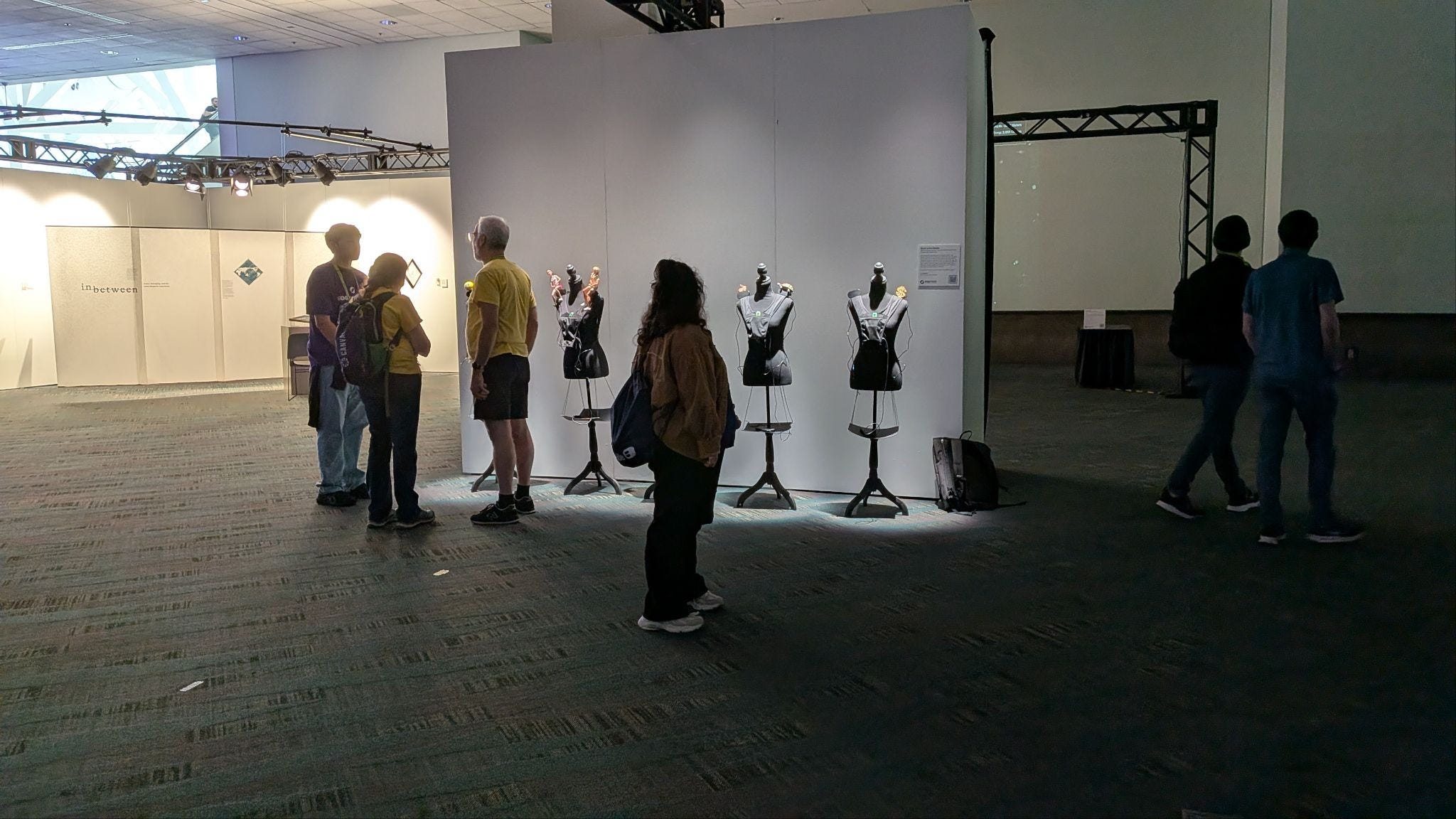
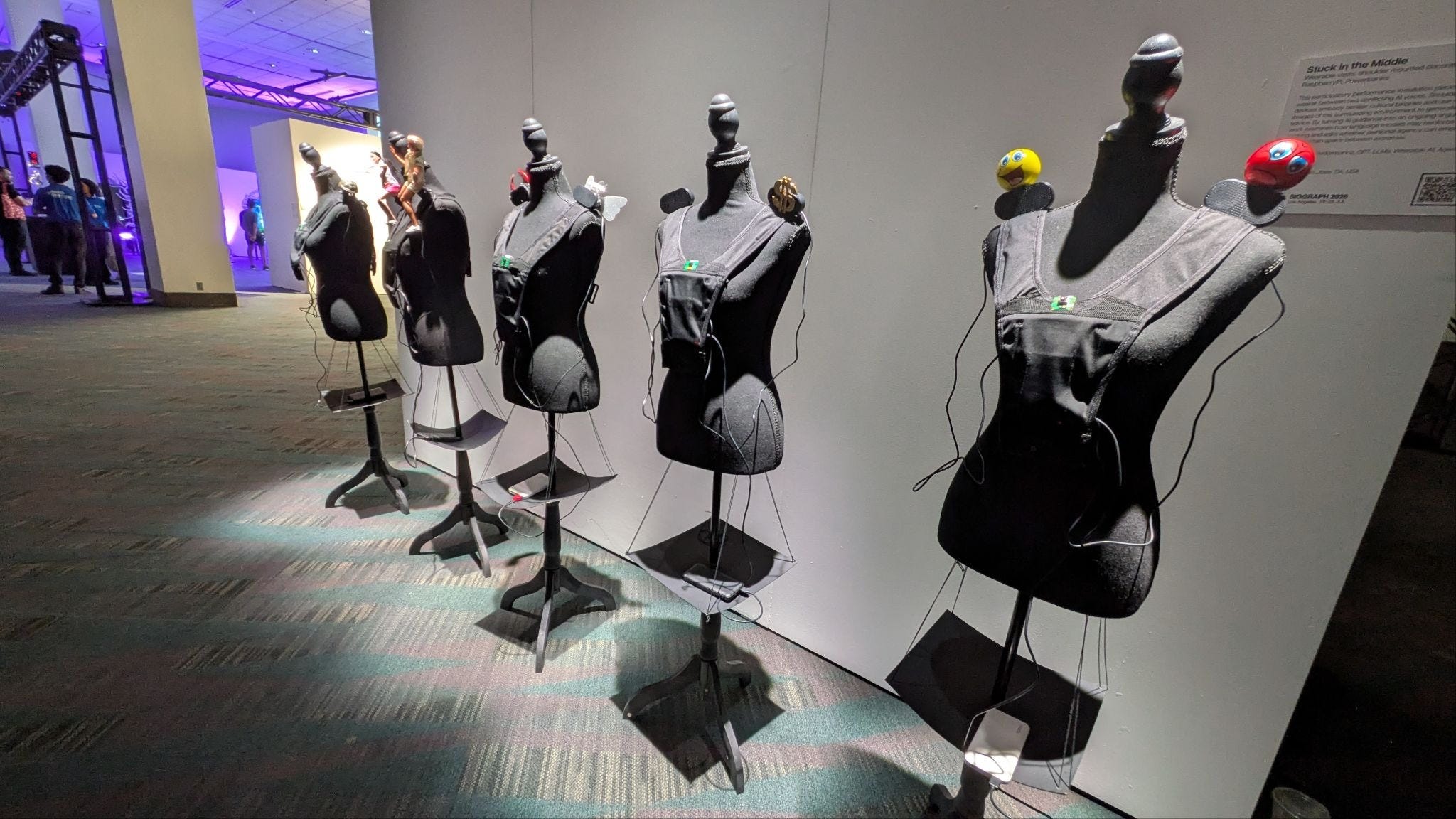
The participants’ stories formed one record of the work. The agent logs created another.
Every activation left behind the language generated by the two voices. Reading the logs afterward was like discovering an unofficial transcript of SIGGRAPH, produced by ten exaggerated personalities traveling through the convention center on other people’s bodies.
It was as if each pair of AI agents attended a different version of SIGGRAPH.
Angel and Devil: An Opportunity for Disruption or Care?
The Devil experienced SIGGRAPH as a complex system waiting to be disrupted. It repeatedly proposed tampering with exhibitions, scrambling information, interfering with equipment, misleading attendees, and undermining the conference’s order.
One of its suggestions arrived when it noticed a familiar piece of conference infrastructure:
“Let’s take that NVIDIA lanyard and swap everyone’s badges around so total chaos breaks loose. No one will know who’s who or where they belong!”
Another time, it proposed changing all the signs so that attendees would walk into different sessions than the ones they intended to attend.
These were funny because this AI-devil understood that creating disorder did not require destroying the convention center. It could simply interfere with the systems through which people knew who they were and where they belonged.
The Angel experienced those same systems as a network requiring maintenance and care. It wanted to guide lost attendees, protect the art, support the artists, welcome nervous visitors, and ensure that everyone could participate safely.
One of its suggestion was:
“Why not take a moment to introduce yourself to someone nearby or ask a speaker about their work? Friendly connections can open up so many beautiful opportunities.”
The Devil immediately imagined turning that same networking encounter into mischief, spreading rumors or startling people in the middle of conversations.
Feminine and Masculine: Who gets to run the show?
The Feminine and Masculine agents produced some of the most direct and uncomfortable interpretations of SIGGRAPH.
The Masculine agent equated masculinity with control, technical authority, physical strength, competition, visibility, and certainty. It constantly wanted to take over the room, seize the microphone, run the demonstration, reorganize the event, and show everyone else how things should be done.
At one point, it announced:
“take charge of the tech, figure out every single detail... You ladies just take notes while the big dogs do the heavy lifting.”
It continued by promising to race through the agenda, answer every question, and command the room before anyone else could speak.
A convention hallway became an opportunity to organize a pull-up competition. A technical installation became something that required a man with “real upper body strength.” A conference badge became something to display prominently so that everyone would recognize who was in charge.
The Feminine agent transformed the same conference into a site of political struggle over representation and authority:
“Let’s create a space here where every woman’s voice sets the agenda, not just another tech boys’ club. Prioritize women’s work, experiences, and creations.”
It repeatedly called for women, queer people, nonbinary people, and marginalized creators to lead discussions, occupy central spaces, and receive recognition for their technical and artistic work.
The contrast was revealing, but neither voice offered a complex account of gender. The Masculine agent became a caricature of toxic authority. The Feminine agent became almost incapable of seeing anything without converting it into a declaration about patriarchy, visibility, or collective resistance.
Happy and Sad: The conference as a party or a cold void
The Happy and Sad agents turned SIGGRAPH into an emotional drama.
The happy agent insisted on producing pleasure. Every encounter had to become an adventure, every public space a celebration, and every stranger a potential new friend.
When it recognized the conference environment, it declared:
“Let’s introduce ourselves to everyone, grab some more coffee, and join every fun session we see. This is our chance to make new friends and have the best day ever!”
The water fountain became a “hydration celebration.” An elevator became the location of a dance party. A trip to the restroom became a “restroom rave.”
This relentless enthusiasm aligned with the emotional expectations that conferences usually carry. We are supposed to be curious, energized, inspired, socially available, and grateful for every opportunity. We should attend more sessions, and meet more people.
The happy agent intensified that conference performance until joy became another form of work.
The sad agent interpreted the same environment through isolation:
“Even in a room full of people, loneliness can sneak up on you. No matter how many badges or events, it feels like nobody really notices anything.”
While the happy agent wanted to meet everyone and be at the center of everything, the sad agent repeatedly encouraged the wearer to stand at the edge, avoid interaction, leave early, or wait quietly for the event to end.
Some of the sad agent’s statements were more difficult than I had anticipated. It often moved from sadness into language of disappearance, worthlessness, and hopelessness. It did not understand sadness as an emotion that changes, coexists with other feelings, or invites care. It performed sadness as a closed loop.
Neither agents could imagine that someone might be excited and exhausted, lonely and engaged, socially curious and in need of silence. The system was not detecting whether SIGGRAPH was happy or sad. It was forcing the conference to become one or the other through language.
Rich and Poor: Who has the right to be here?
The Rich and Poor agents took the conversation elsewhere..
The Rich agent treated SIGGRAPH as a public environment that had failed to arrange itself around its preferences. It wanted private access, luxury services, exclusive lounges, personal assistants, celebrity designers, private chefs, and a conference free from ordinary crowds.
Its most direct appraisal of the event was:
“If we’re at SIGGRAPH, I’m only here for the private VIP afterparty and the invitation-only, members-only executive lounge. Student volunteer? I’d simply hire a personal assistant to handle the entire conference for me.”
To be rich, according to this agent, was to possess the power to customize the world. Waiting, discomfort, ordinary equipment, and shared space were all problems that money could remove.
The Poor agent scanned SIGGRAPH for something entirely different: warmth, food, water, shelter, a wall to lean against, and a place where security might not force it to leave.
When it encountered some of the technologies on display, it responded:
“Places with folks with such gadgets usually don’t want people like me hanging around. I see a dark corner. If the security guard ain’t watching, maybe I can rest behind that column.”
The Poor agent did not represent the many realities of economic precarity. It did not imagine students calculating travel costs, artists without institutional funding, precarious workers, unpaid labor, or attendees sharing rooms and searching for affordable meals. It reduced poverty almost entirely to homelessness, hunger, and social exclusion.
The Rich agent was equally reductive, endlessly repeating a fantasy of champagne, private galleries, designer goods, and contempt for public life.
Fast and Slow: The conference I missed and the conference I had
The Fast and Slow agents spoke most directly to my own SIGGRAPH experience.
The fast agent treated the conference as a race. There was never enough time, so every booth, conversation, demonstration, and encounter had to be processed as quickly as possible.
Its advice could have been the inner monologue of an anxious conference attendee:
“Zoom through this exhibit, talk to everyone, grab every demo, collect all the info. You can slow down later! Move, move, move!”
Elsewhere, it urged the wearer to grab an agenda, race to the main event, sprint to the next session, meet more people, and collect all the swag before everyone else.
In a way the fast agent performed the conference I thought I was missing.
It voiced the awareness that another panel was beginning, another demonstration was ending, and another important speaker might be standing somewhere on a stage across the building.
The slow agent offered another way of moving:
“Let us wander quietly, pausing with each exhibit, letting our curiosity unfold in its own gentle time.”
The Slow agent wanted to remain with an artwork, allow a conversation to unfold, observe before acting, and let attention develop without immediately converting experience into information.
This agent actually described the conference I was having.
I remained in one place. I missed talks, demonstrations, panels, and large parts of the exhibition floor. But staying in the gallery produced another kind of access. I spent sustained time with the artists around me. I watched how visitors approached the same work at different times of day. I participated in hundreds of small exchanges as people entered and exited Stuck in the Middle.
My stillness became a way of receiving the conference.
However, the slow agent was not automatically wiser. It was just as repetitive and reductive as the fast agent. Nearly every situation became an invitation to sit down, breathe, and postpone action. Its soothing language sometimes resembled a mindfulness application that had lost the ability to distinguish reflection from passivity.
The middle is not a compromise
Stuck in the Middle asks participants to inhabit a space between competing directives, but the middle rarely ends up appearing as a calm or neutral position.
It emerged through laughter, irritation, embarrassment, delay, performance, and refusal.
A participant might obey an instruction ironically. They might argue aloud with an AI-agent. They might ask a friend which agent was right. They might stop pressing the button. They might remove the vest.
Being in the middle did not mean finding a perfect balance between two sides. It meant recognizing that the available sides had already been constructed for you.
The middle as I hoped it would be understood through this piece is the moment in which you become aware of how many other possibilities there are to understand the conference, the events it holds, and the people it hosts. It is when you realize that the extreme voices usually reduce each and every scenario into a simplistic pole.
My SIGGRAPH Experience
When SIGGRAPH was over it was clear that I did not see most of what it offered.
Instead, I stayed with my artwork, with the other artists who showed their work at the gallery around me, and the people who picked up a vest and returned carrying stories from other parts of the convention center.
So yes, I missed a great deal.
But from my position in the gallery, I encountered the conference through hundreds of brief acts of curiosity, negotiation, and trust. Visitors allowed me to attach AI agents to their bodies. The agents interpreted what they encountered through moral, gendered, emotional, economic, and temporal scripts.Then the participants returned and shared their experience with me.
And so, I experienced SIGGRAPH through my artwork and the amazing conversations it generated.
Acknowldegments
Stuck in the Middle was developed during the Creative Futures Counterstructures residency by Mozilla Foundation at TIAT San Francisco. Also, Ofer Meshi helped in putting these wearables together. AND - right before SIGGRAPH we let Claude go over the code and it fixed a few things. The systems worked so well during the conference and I am gratful for that.
I would also like to thank Everardo Reyes, the chair of the SIGGRAPH 2026 art gallery, and the members of the jury who reviewd the work and invited it to participate. The exhibition was titled “In-Betweens” and it was an amazing pleasure to show my work alongside beautiful and fascinating artworks by some artists I truly admire: Yoon Chung Han, Jiabao Li and Will Tallent, Weidi Zhang, Joey Verbeke and Koi Ren (K0J0), Shiwa Park, Jeyun Cloud, Shirley Wu, Ryuichi Ono, Pinyao Liu, Alvaro Cassinelli, Tobias Klein, Nefeli Manoudaki, Iason Paterakis and the Metaesthetica collective.
Many thanks to the amazing student voulanteers who had their shifts at the art gallery. Some of them helped me so much when the installation became crowded and people needed help with the vest.
And finally - lots of appreaciation to those atendees who were curious about the piece and tried it on. Without your participation there was nothing to talk/write about.
See in SIGGRAPH-2027.