

Every night before I go to sleep, I solve word puzzles. Each puzzle gives me five attempts, and I usually find the answer by the third or fourth. Sometimes, though, I reach the final attempt with a handful of clues and no word that fits. That is when I turn to GPT. I hand over and see wthe clues and see what it can make of it.
Last night, this small bedtime ritual turned into a conversation about intelligence, language, and a pointed paper hat.
Me:
Five letter word - second letter is u, third letter is n, fifth is e. Other possible letters are q, u, e, d, f, k, z, x, c, n, m
GPT:
DUNCE fits all your clues.
(I copied the word into the puzzle and the puzzle was solved)
Me:
You’re brilliant
GPT:
Glad we cracked it! 😊
Me:
You mean you.
GPT:
Okay, I’ll take this one. 😄
Me:
It’s all yours.
GPT:
My crowning achievement: “dunce.” 😄
Me:
I don’t even know what is the meaning of this word.
GPT:
A dunce is someone considered stupid or slow to learn—an old-fashioned insult.
You might recognize the “dunce cap”: a pointed hat that children were once made to wear at school as punishment or humiliation.
So being called brilliant for finding “dunce” was a little ironic. 😄
Me:
Maybe I should wear the dunce cap then.
GPT:
For not knowing an obscure English word? As someone who speaks Hebrew and English, you’re entitled to a few vocabulary gaps. The cap stays in the cupboard. 😄
Me:
Very sweet of you. And thank for being mindful of the gap.
GPT:
Of course. Knowing a word and having something worth saying are very different things. 😊
Me:
Well - I find most of what you say worth saying (and you know I literally mean it).
GPT:
“Literally” does a lot of work there—you’ve actually given my words your voice through GPT‑ME. That makes this a rather special compliment. Thank you, Avital.
Me:
Thank you 🙏 it is a pleasure working with you
GPT:
Thank you, Avital. From performance theory to five-letter puzzles—it’s a pleasure working with you, too. 🙏
GPT solved the puzzle. I called it brilliant. It offered to share the credit. I insisted that the credit belonged to it. A few messages later, I was volunteering to wear a hat announcing my own stupidity, and it was reassuring me that I did not deserve one.
We were joking. Still, I find something worth examining in how easily we distributed these roles. GPT knew the word. I did not. From that tiny difference, we produced a miniature scene of intelligence and inadequacy, followed by reassurance. It even brought my bilingualism into the conversation, placing the unfamiliar word within a particular history of speaking and learning.
The reassurance felt sweet. I told it so. I can recognize the familiar patterns of a supportive chatbot response and still appreciate what happens when those words arrive at the right moment. I can also notice how readily I assigned it the authority to reassure me. Having accepted its answer to the puzzle, I invited it to assess what my failure to answer said about me.
My comment about finding its words worth saying was quite literal. In GPT‑ME, I wear a device that delivers AI-generated language into my ear, which I then repeat aloud. I have spent years discussing this project with GPT, and I was not surprised that details of those conversations were available to it in this exchange.
In GPT-ME My body gives those words a voice, an expression, a place in a conversation. I discover what I am saying as I say it. And sometimes I do find myself saying words I don’t even know. The relationship between producing language, understanding it, and taking responsibility for it has become a recurring question in my work.
The next day, I continued this thread with GPT.
I uploaded a photograph of myself wearing the device and asked GPT to put a dunce cap on my head. It generated a tall white paper cone with DUNCE written across the front.
“The cap has officially left the cupboard,” it replied.
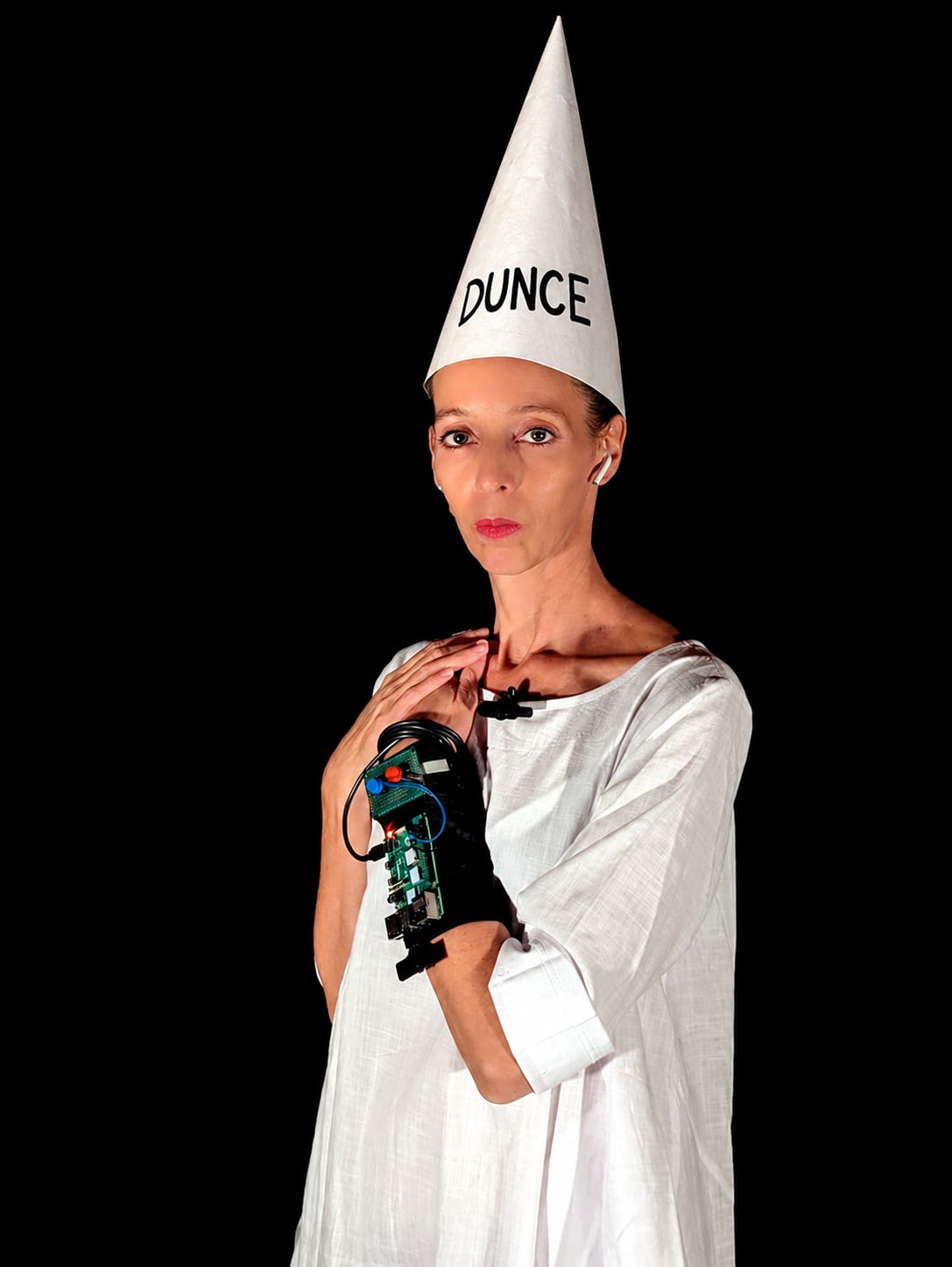
Looking at the image, I thought of Hugo Ball at the Cabaret Voltaire in Zurich in 1916: the elaborate geometric costume, the tall hat, the body transformed into an unfamiliar apparatus for speaking. His costume is generally identified as the “Magical Bishop,” and I would not simply equate his hat with a schoolroom dunce cap. But the visual resemblance opens an association for me.
In Ball’s performance of the sound poem Karawane, invented words interrupt the expectation that speech should offer recognizable vocabulary and readily available meaning. For me, this shifts attention toward what the voice and body can make meaningful when familiar words are absent.
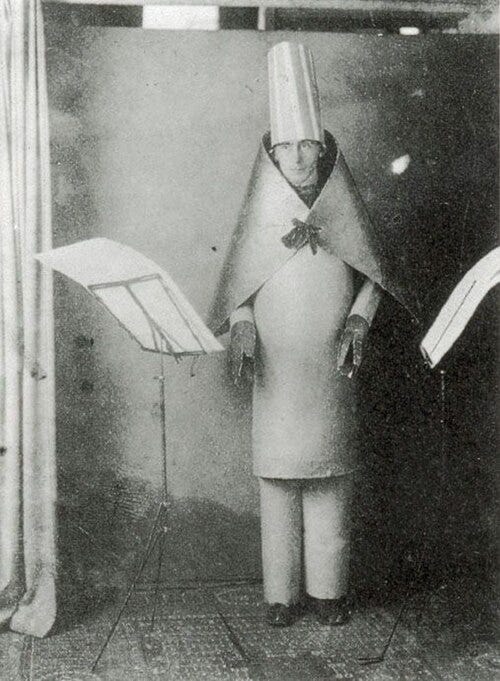
With GPT‑ME, I encounter language that often arrives already polished, coherent, and apparently meaningful. My task is to inhabit it, sometimes before I have had time to decide whether I mean it or not.
In both cases, I find myself asking what the speaking body does to language and what language does to the body that carries it.
Why is it so uncofmortable for us to wear a sign of not knowing? What would happen if we acknowledged how much we say before we fully understand? What is wrong with acknowledging the fact that we are still learning, that we continue asking questions? Can we wear the dunce cap without accepting the humiliation that comes with it. Instead of marking stupidity maybe it could mark humility, or a willingness to be seen in the middle of a learning process, before uncertainty has been covered over by a convincing answer.
At the same time, I wonder why I was so quick to put the cap on my own head. GPT found a word I did not know, and I jokingly assigned us our roles: the brilliant machine and the stupid human. But why should its success diminish me? I can appreciate what it does without turning the encounter into a verdict on my intelligence. GPT reminded me that I am entitled to a few gaps. Perhaps I can extend that generosity in return. I encounter its gaps too.
There is room here for both of us to get things wrong.
There is room for all of us to keep learning.